Emerald Sound: Tropical Glass House Overlooking Sydney’s Emerald Bay
Emerald Sound sits above a quiet bay in Sydney, Australia, where Luigi Rosselli Architects rework a 1970s house into a coastal retreat shaped by glass and light. The renovation leans into the site’s subtropical character, pairing a recycled structure with vivid emerald tones, intricate louvres, and a courtyard garden that draws the landscape inside. Interiors by Atelier Alwill and the clients sharpen this palette, tying house and water together in one clear narrative.


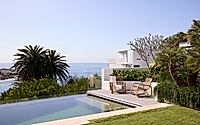
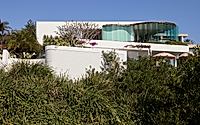
From the steep sandstone slopes above the bay, the water reads as a sheet of glassy emerald. Sun hits tiled walls and brass details, and color rebounds. A once-introverted trophy home now greets its setting with courtyards, louvres, and warm timber that catch the breeze and the changing light across the day.
This house in Sydney’s eastern harbor fringe is a renovation by Luigi Rosselli Architects, turning a well-built but flawed 1970s structure into a coastal home oriented to water and garden. Working with a client embedded in the glass recycling industry, the team keeps the bones of the existing building and focuses on reprogramming, light, and an emerald-toned interior palette. The result favors daily use and tactile finishes over bravado, with a sequence that tracks from shaded courtyard to elevated veranda.
Reclaiming The Ground Level
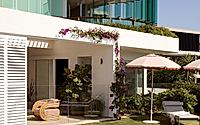
The transformation begins where the house meets the street. What had been a driveway and garage swallowing most of the ground floor becomes a secondary living area and garden courtyard. A new ramp directs cars down to a large, underused basement instead, freeing the main level for people, plants, and air.
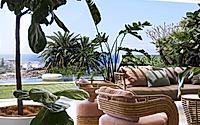
In this recovered territory, the designers clad courtyard walls in teal blue chevron mosaic tiles reminiscent of the local Blue Groper fish. When sun pours in they read as vivid blue, and in shade they drift toward green, backing a dense subtropical planting that climbs and spreads. The room between tile and foliage turns into a cooled outdoor room, tuned by color and shadow.
Living With The Courtyard Garden
Entry now moves through this tiled garden court. Beyond the planting, a large single pane of glass reveals the main stair, its brass accents catching light against a woven screen. That glimpse sets the tone: refined but not polished to sterility.
Each morning, movement from the bedroom level down the stair runs directly toward the courtyard. The descent echoes high houses of tropical regions, where elevated rooms drop into greenery and air, reinforcing the link between everyday routine and the planted heart of the house. The courtyard no longer sits as a leftover gap; it becomes a hinge between interior rooms and the bay beyond.
Emerald Louvres On The Bay
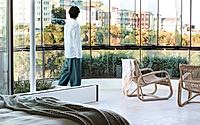
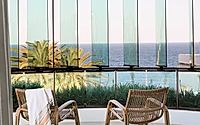
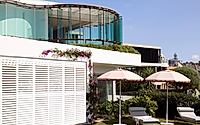
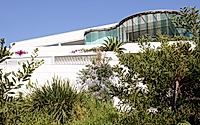
Upstairs, bedrooms command broad views across the narrow sound and its ring of houses stepping down the cliffs. For the main suite, privacy and climate control are handled with a contemporary veranda variation in glass. A covered shelter wraps the room, fully glazed yet capable of opening wide to capture warmth and breezes from the water.
The key element is a run of vertical curved glass louvres, developed with Tilt Industrial Design. Originally the team hoped to reuse glass from a conservatory that once dominated the living level, but laminated panels resisted recycling. Instead, emerald glass from the client’s neighbor, Australia’s largest glass producer, is custom cured and tempered so each blade shimmers in sunlight like scales.
Mechanical gears and chains sync the louvres, while high-grade stainless steel and UV-resistant resins handle the marine air. Opened or closed, the assembly reads as a translucent screen between bedroom and bay, filtering view, wind, and glare in one controlled surface.
Interior Palette In Motion
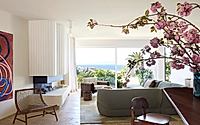
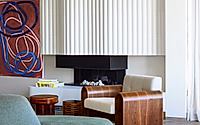
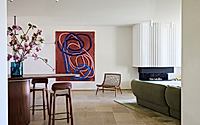
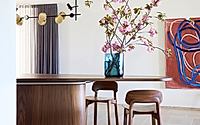
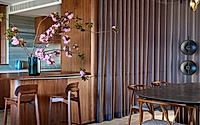
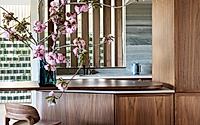
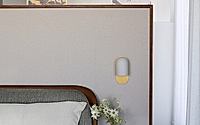
Inside, Atelier Alwill works with the clients to extend the emerald thread without overwhelming it. Accents appear in tilework and sanitaryware, picked up again in glimpses of the courtyard and the louvres. Against these saturated notes sit rich American walnut joinery, aged brass hardware, and stone tiles in soft sandy hues.
The walnut brings depth and grain to cabinets, stair elements, and built-in furniture, while brass softens at touchpoints over time. Sandy stone underfoot links back to the surrounding sandstone cliffs, grounding the more expressive green and blue surfaces. Across the house, that calibrated mix of cool color and warm material ties the recycled structure to its coastal setting.
By the end of the day, when light drops and the bay darkens, the house reads as a series of warm-edged rooms cupping a tiled garden and a glass veranda. Water, vegetation, and interior finishes stay in dialogue, each catching the other’s color. The once inward-facing 1970s shell now gives back to its site, through texture, refraction, and carefully tuned everyday rooms.
Photography by Prue Ruscoe and LRA
Visit Luigi Rosselli Architects