Casa Cosmos: Rammed Stone and Exposed Concrete on a Sloped Site Edge
Casa Cosmos is a house in Capilla del Monte, Argentina, designed by Estudio Cristian Nanzer in the foothills of the Punilla Valley. Designed in 2024, it uses a triangular plan to orient daily life toward three distinct horizons while anchoring the rooms around a central social core. Heavy walls, shaded galleries, and a skylight make light, privacy, and climate the project’s main instruments.


About Casa Cosmos
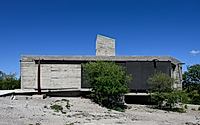
Casa Cosmos, named by its owner after seeing it standing on the site, sits in the foothills of the Punilla Valley in Capilla del Monte, Córdoba, Argentina. The plot borders a protected natural reserve marked by dense woodland of red quebracho, black algarrobo, chañar, and aromito, all species native to this semi-arid region. Its topography falls sharply from east to west and drops steeply to the south toward the reserve.
Concept
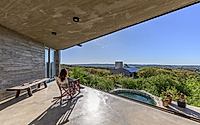
The house is conceived as a panoptic device. From a central point on the site, its geometry opens toward three specific landscape views: the reserve and Las Gemelas hills to the south, Mount Uritorco to the northeast, and El Cajón Dam to the west.
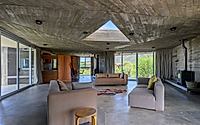
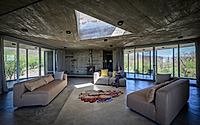
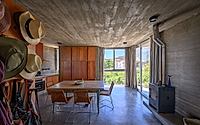
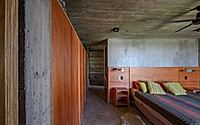
That decision produces a triangular matrix that organizes the rooms around a central social core. The kitchen and dining area connect directly to this center, while an en-suite bedroom and a studio extend from it. Heavy walls separate these quieter rooms, regulating privacy and adding thermal mass that supports environmental stability.
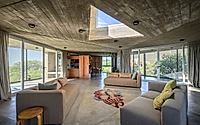
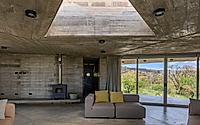
At the center of the house, a triangular skylight filters daylight in a diffuse way and provides a constant reading of the diurnal cycle. As the light shifts, it acts as a chronometer, registering the passage of time.
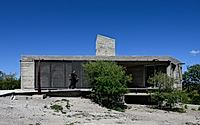
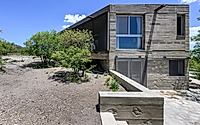
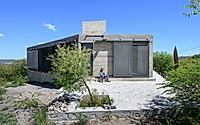
The spatial experience recalls a diaphanous cave: a heavy polyhedral mass hollowed out at three strategic, equivalent points. These thick voids become deep galleries that shelter the large openings and cast dense shade. Three semi-heavy expanded metal sliding shutters complete the system, modulating light, slowing airflow, and improving security.
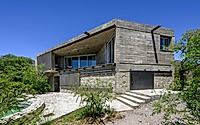
The project uses the site’s slope to gain height in the principal rooms. A plinth absorbs the existing grade change and establishes a new datum for the main floor. Within this base are an autonomous residential unit, technical rooms, and storage areas.
Materiality
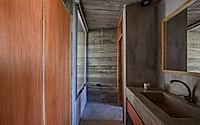
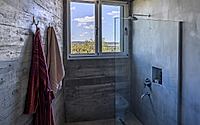
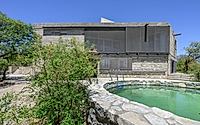
The plinth is built with 40 cm (15.7 in) thick rammed stone walls that retain the earth and consolidate the new ground level. Above it, the main floor is formed with board-formed exposed concrete walls. Thermal insulation is integrated into the exterior wall assembly, reinforcing the building’s hygrothermal performance.
Its architectural expression comes directly from exposed material. Construction methods and local techniques remain legible, and the arid character of the surrounding landscape continues into the exterior walls, then carries into the pared-back interior rooms.
Here, light is the omnipresent material. Its movement and chromatic shifts register the hours of the day and the cycles of the year. The house takes in that condition and presents itself as a primitive instrument for seeing time, a device that places its inhabitants in direct relation with the site.
Photography by Gonzalo Viramonte
Visit Estudio Cristian Nanzer