Casa Kendo by Ortega Diago
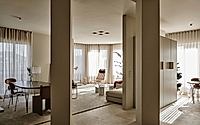
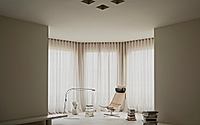
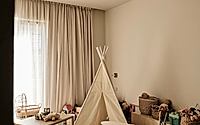
Casa Kendo is an apartment by Ortega Diago in San Sebastian, Spain, set on the seventh floor of a late 19th-century building. Designed in 2026, the project makes natural light its main ordering element, using a widened hallway, glass block screens, and continuous Campaspero stone surfaces to shape a calm, inward-looking home. Furniture and lighting pieces extend that restrained atmosphere without disturbing it.


About Casa Kendo
Ortega Diago, the architecture studio founded by Gonzalo Sánchez Ortega and Armando Diago, presents Casa Kendo. Located on the seventh floor of a late 19th-century building in San Sebastian, the intervention uses its height and favorable orientation to make natural light the project’s real driving force, shaping a serene home with a quiet, contemplative atmosphere.
Rather than trying to reconstruct a historical past or force a relationship with the building’s original context, the proposal turns inward. It explores the different scales that coexist within the floor plan and the way they are crossed, giving priority to the inhabitant’s experience over ornament.
A Layout That Structures And Sifts Light
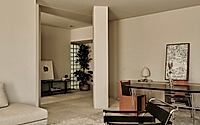
The home’s organization follows a clear logic in which each decision aims to be essential. The project rethinks the traditional role of the hallway, usually reduced to a leftover passage. In Casa Kendo, that element gains thickness and character: it widens, moves closer to the rooms, and becomes part of them.
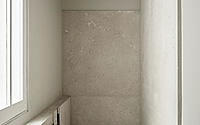
More than a simple distributor, it works as a backbone that orders life in the apartment through bold volumes. That sequence is enriched by the precise use of glass block screens, which filter the light and introduce a different texture, breaking the solidity of the walls and extending visual continuity.
Campaspero Stone As A Continuous Canvas
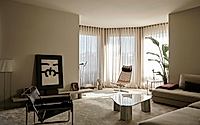
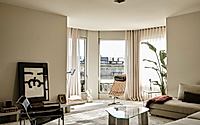
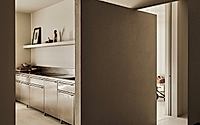
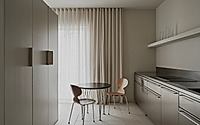
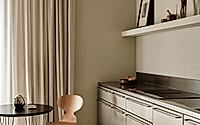
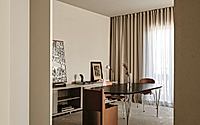
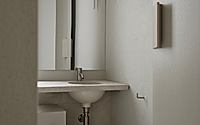
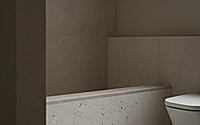
The material palette seeks an atonal presence that accompanies the light rather than competing with it. The studio chose sandblasted Campaspero stone as the unifying element. It unfolds as a continuous surface across floors and vertical cladding, able to absorb the intense light of the seventh floor and reflect it back in a softer register.
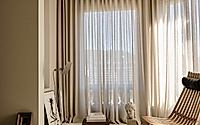
This strategy becomes especially clear at sunset. As the studio explains, when afternoon light glides across the stone, the interior takes on an unexpected and intimate density. In that way, the apartment becomes a calm setting for daily life, where architecture remains present without imposing itself.
A Dialogue Between Design Classics And Bespoke Furniture
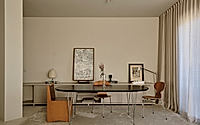
Within that atmosphere of restraint, the interior is completed by a careful furniture selection that works in dialogue with the sobriety of the stone. Pieces by Fritz Hansen, including the Ant chairs and dining table, sit alongside the Akari lamp by Vitra and contemporary designs such as the Scandia chair by Fjordfiesta.
Particularly notable is the inclusion of the studio’s own work, including the Tarugo Chair by Ortega Diago, which gives the ensemble a more specific identity. Technical and decorative lighting with pieces by Álvaro Siza, together with Vola fixtures, complete a project that invites a renewed awareness of everyday life and a more conscious relationship with the home.
Photography by Mari Luz Vidal
Visit Ortega Diago