Araucarias House – A Quiet Retreat for Guests Stays
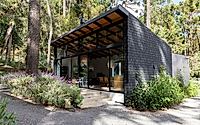
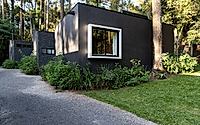
Araucarias House sets two compact dwellings amid the cool, pine-covered slopes of Campos do Jordão, Brazil. Designed by ARKITITO Arquitetura in 2024, the house uses durable assemblies to meet mountain moisture and cold. The real estate type is a house that splits into a main residence and a guest house, each with social and private wings, reading as a pair of dark, low volumes bridged by a bright metal hall.


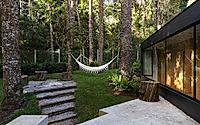
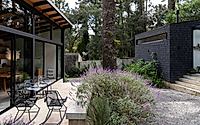
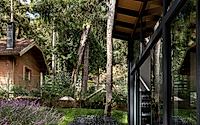
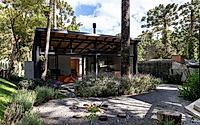
Pine shadows slide across dark facades as light washes the glazed hall. Concrete thresholds catch the sun through the trees, pulling the eye from forest edge to interior.
This is a house in two parts, set in Campos do Jordão with a guest twin alongside the main residence. ARKITITO Arquitetura lays out compact social and private wings, then connects them with a glass-roofed metal hall that lifts daylight and punctuates the darker skins.
Elevate Against Moisture
Each volume rises a few centimeters above grade to resist wet ground and uneven terrain. That small lift—simple and pragmatic—keeps structure clear of soil while preserving roots and the natural fall of the site. Concrete block walls form the core, with vermiculite-filled outer layers improving thermal and acoustic control through cold nights and quiet mornings. The result is robust fabric that holds warmth and dulls mountain wind.
Wrap Roofs for Warmth
Roofing shifts by program to serve performance first. Flat panels over bedrooms act as technical slabs, creating a tidy plane for services while stabilizing indoor temperatures across daily swings. Social rooms use a metal structure with asphalt shingles that turn down the sides, deepening the insulating envelope and sharpening the building’s profile against the trees. It reads clean and works hard.
Frame Openings in Concrete
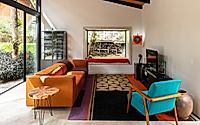
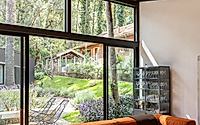
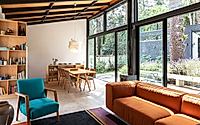
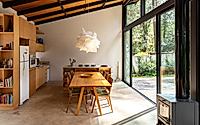
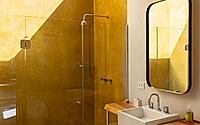
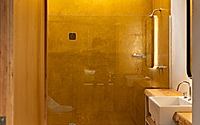
Where the forest side opens, concrete projections thicken window edges and make places to sit, set a plant, or pause between inside and out. Large apertures slide toward concrete decks, extending meals and conversation into the open air with a direct line to the pines. Bathrooms pull light from above through impact-resistant skylights sized to shrug off falling pinecones and nuts. Rustic yellow concrete inside those rooms warms reflected light and cuts the chill.
Plywood and Ironwork
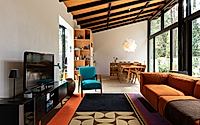
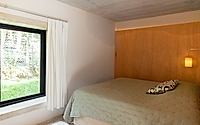
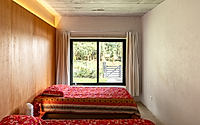
Materials skew durable and unfussy for a vacation rhythm. Natural-colored polished cement underfoot and yellow burnt cement in baths meet black ironwork and white plaster walls, all chosen to weather use without fuss. Marine plywood carpentry stays exposed for resilience in humidity, running from corridor cladding to bedroom doors and headboards with integrated indirect lighting (a quiet, continuous detail). It feels honest and built to last.
Light the Passage
The connecting hall runs metal and glass to pull daylight into the plan and relieve the darker exteriors. It acts as threshold and hinge, linking social and private wings while orienting movement between the two houses. By day it glows; by evening it gathers warmth at the core and steadies circulation between rooms. The move is simple and legible.
Landscape planting keeps the middle of the lot open while stitching native species along edges and walls. Birds and small fauna find cover, and the view breathes between trunks and decks. As sun shifts, concrete, plywood, and iron pick up a soft sheen, and the forest atmosphere slips indoors without fuss.
Photography by Andrea Soares
Visit ARKITITO Arquitetura