Sleeping Lab·Tang by Atelier d’More
Sleeping Lab·Tang sits in Beijing, China, conceived by Atelier d’More as a hospitality project with a crafted touch. Set at a key village crossroads near Universal Studios, the reworked B&B turns a once-abandoned compound into a calm, white-walled retreat. The team preserves the existing framework while reshaping the entry and courtyards into a coherent sequence that brings daylight, privacy, and a sense of flow.


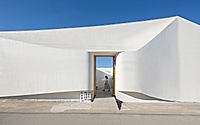
White tones catch the morning glare as the corner mass lifts in a gentle recess. The entrance curves inward, a quiet gesture that pulls the village street into the threshold.
This is a B&B in Tangdazhuang Village, Beijing, reworked by Atelier d’More from an abandoned renovation into a coherent small hotel. The architects keep the core structure, reshape circulation, and focus on a crafted facelift—minimal moves that change how the building reads and how guests move through courtyards and rooms.
Rework the Corner
The street facade once staggered between flat and sloped rooflines, a patchwork lacking order. From the four corners of a new arch at the entry, the designers extend lines to the building’s edges, then soften them into an inward curve that forms a rain-shedding canopy without looking add-on. One move, many gains: shelter, identity, and a sense of motion along the village crossroads. The flat wall reads sculptural, and the corner now addresses the street with calm intention.
Link Two Courtyards
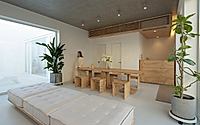
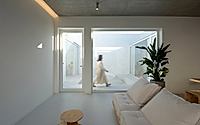
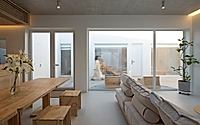
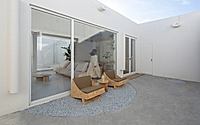
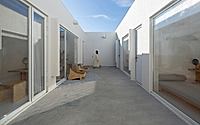
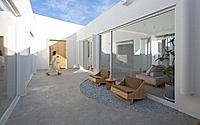
Two existing courts set the project’s rhythm, one open and ordered, the other enclosed for privacy. The team assigns the front court a symmetrical, white composition and uses the main hall as a clear connector between front and rear. Large floor-to-ceiling glass keeps the courts in conversation, letting light and views cross the plan while holding different degrees of retreat. Guests move from public welcome to quieter rest without breaking cadence.
Lofted Family Rooms
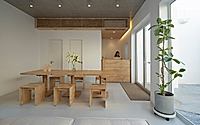
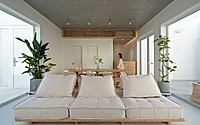
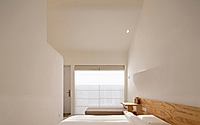
Inside the sloped-roof wing, earlier steel inserts for mezzanines become lofted family rooms. Rather than erase those clues, the architects refine them, aligning circulation and storage to fit the compact volume. Two front rooms merge into a communal core with a lounge, dining, reception, linen room, and restroom, keeping service uses tight and social life centered. The plan saves cost, reduces waste, and gives each room a clear role.
Handmade Elements
Material restraint leads the work—minimal finishes, strong light, and parts made to fit. Designers prefabricate digitally, then collaborate with on-site artisans to shape exterior walls, water spouts, doors, bed frames, and simple furniture. Off-the-shelf pieces appear only where essential, letting the handmade set the tone and keep the language consistent. The result is a cohesive interior and exterior, spare but tactile, built to gather character over time.
By day the white courtyards throw soft light into rooms; by night the arch glows along the crossroads. The building does more with less, letting reuse and craft drive the experience. A tired corner finds new purpose, and the village gains a calm place to pause.
Photography by Atelier du0027More
Visit Atelier d’More