Bay House by McLean Quinlan Architects
Bay House sits in a coastal village in North Devon, United Kingdom, by McLean Quinlan Architects. The five-bedroom house steps with the hillside, pulling in ocean and valley views while keeping a low profile from the street. Inside, warm oak and light plaster set a restrained mood, aligning with the studio’s low-energy approach and crafted joinery.


Salt air rides the bend in the road as Bay House rounds with it, a pale stone arc set into North Devon’s hillside. From the street the roofline reads quiet, but light pours through deep glazing and the terrain reveals a layered home that falls toward the sea.
This is a five-bedroom house in a coastal village in North Devon, designed by McLean Quinlan Architects. The core idea is simple: build for weather and view, and thread low-energy systems through a resilient shell. Context drives the plan, materials, and daily routine.
Follow the Contour
The plot curves with the road, and the building follows suit, easing its mass into a gentle sweep. Levels step from one to three storeys so the volume never looms, and movement through the house becomes a measured descent toward bigger views. On arrival, it reads as a single ground level; move inside and the plan opens, drawing sightlines out to ocean and farmland. That bend is not a gesture—it’s the site made legible.
Manage Weather, Keep View
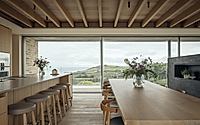
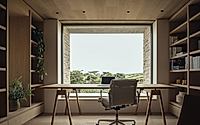
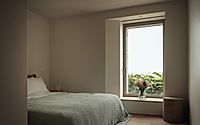
The coastal setting brings wind, glare, and salt, so a robust Purbeck stone facade takes the hit while expansive glazing maintains connection. Floor-to-ceiling panes in the living, kitchen, and dining rooms pull in east and west light, yet the interior stays sheltered from prevailing gusts. Front and rear terraces extend daily life outdoors, and a protected balcony off the main bedroom adds a quiet perch. Deeply inset openings frame the land and temper exposure.
Sequence for Real Life
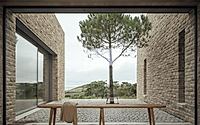
An active family uses this house hard—surfing, cycling, walking—so entry is practical. Bikes, boards, and muddy boots go straight to the garage and utility rooms, keeping the main living areas calm. A study and a generous hall buffer these zones, with floor-to-ceiling glass looking into a sheltered courtyard planted with a local conifer pine. It’s a simple pause—clean gear, clear mind—before moving toward the social rooms.
Light Through the Stair
On the south, a glazed stair hall becomes a light well, screened by angled oak to soften summer sun. The bespoke oak stair floats, letting daylight wash down through the treads and into lower levels. It reads as both circulation and climate tool, a break in the stone envelope that animates the elevation. Three terraces stitch into this descent, giving small outdoor rooms for a morning coffee or a quiet call.
Material Calm Indoors
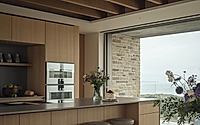
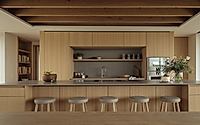
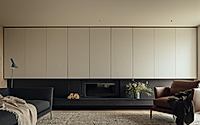
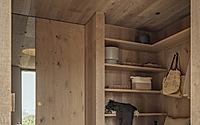
Inside, the palette draws from the coastline: engineered oak floors and wall panels from Solid Floor, light plaster walls, and large ceramic tiles underfoot. Custom joinery in smooth and rough-sawn oak, with brushed brass hardware, brings a precise, tactile rhythm across rooms. An oak bench in the entry—designed by Fiona McLean—sets the tone: practical, warm, and built to last. The effect is quiet, not plain.
Passive Logic, Hidden Tech
Airtight, highly insulated construction pairs with a ground source heat pump and mechanical ventilation heat recovery to reduce demand. Above, a green roof tucks behind a slight parapet, hiding a large photovoltaic array from view while softening the outline. Along the rear elevation, a continuous 80 centimetre (31.5 inch) void runs the length of the house, carrying services and creating a protective buffer against damp. It’s a quiet move that extends performance and futureproofs maintenance.
Garden in the Dunes
Outside, Eden Design sets local dark grey granite against native coastal grasses, knitting the house into the slope. Purbeck stone picks up the tones of nearby sand, reading calm in overcast light and sharp in sun. Paths slip between terraces so indoor rooms meet planted edges without fuss. Wind passes, but the garden holds.
By late day, the stone warms and the oak deepens, and the house settles back into its curve. Views widen, then fold down to the courtyard’s single pine. Built for weather and for people, Bay House keeps its footing while the coast keeps moving.
Photography by Jim Stephenson
Visit McLean Quinlan Architects