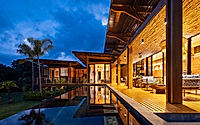
Casa Dos Playas: Earthen Costa Rica House Between two Seas in Balance
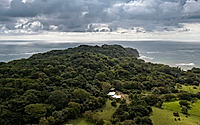
Casa Dos Playas sits between jungle and Pacific in Nosara, Costa Rica, a house by Salagnac Arquitectos that leans into earth, breeze, and shade. The project organizes family life across three low volumes, using fired clay brick and a lifted wood frame to temper heat and humidity while keeping daily routines close to the garden. Everything orients toward balance rather than spectacle, with construction choices driving both climate comfort and a calm interior mood.


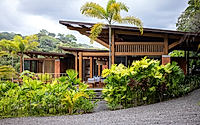
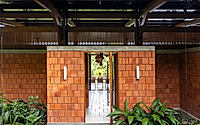
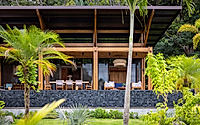
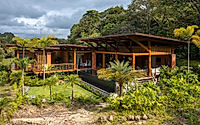
Warm air hangs above the Pacific as the house rises on slender stilts, its brick planes grounding the lighter wooden frame. Light cuts across the porous clay walls, throwing soft shadows into gardens and covered walks that stay breezy even in the afternoon heat.
This is a house of parts but also of one material story. Casa Dos Playas in Nosara, Costa Rica, is a coastal house by Salagnac Arquitectos that treats fired clay as both structure and climate moderator. The layout splits social life, secondary bedrooms, and the primary suite into distinct volumes, yet the earthen brick, lifted wood structure, and open-air circulation stitch everything into a single, grounded experience.
Brick Walls Shape Climate
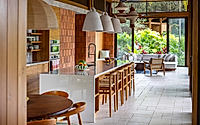
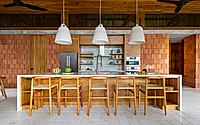
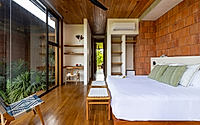
Fired clay walls form the first line against the intense southern sun, their mass and thickness absorbing heat before it reaches interior rooms. Clay’s natural ability to regulate temperature and humidity turns these rooms into consistently cool refuges, without relying on mechanical air conditioning or sealed envelopes. The rough, orange brick carries local building heritage into a new configuration, reading neither strictly traditional nor strictly modern but firmly of the place.
Wood Structure On Stilts
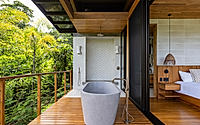
Above the brick, a laminated wood structure rests lightly, its elevated frame touching the ground in a careful grid of stilts. Air, runoff, and plant life move freely under the house, a simple move that respects tropical conditions while protecting the timber from constant moisture. The contrast between dense earthen walls below and the lighter structural rhythm above gives the composition a clear hierarchy and keeps construction legible from every angle.
Three Volumes, Open Links
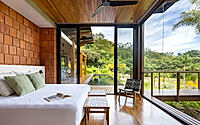
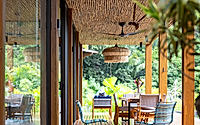
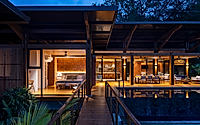
Life unfolds across three main volumes: a sociable core for gathering, a wing for secondary bedrooms, and a quieter primary suite set slightly apart. Bridges and internal gardens mediate between them, so each passage becomes a short walk in open air rather than an enclosed corridor. Wooden louvers temper sun, wind, and rain along these routes, filtering views while allowing breeze, scent of wet soil, and coastal air to move through.
Earthen Surfaces And Well-Being
Brick is more than structure here; its porous surfaces engage acoustics, touch, and the rhythm of daily routines. Walls dampen exterior noise and give rooms a hushed, grounded character, while the mineral texture picks up changing light through the day. Clay’s chemical-free composition and slow thermal behavior support a subtle sense of comfort, the kind that registers in the body long before it turns into words.
As day cools and garden smells deepen, the house reads as a quiet threshold between earth and sea. Elevated timber, earthen walls, bridges, and planted courts work together to keep climate and construction in steady dialogue. In that balance, Casa Dos Playas shows how building with clay can still feel current, while gently returning coastal living to material roots.
Photography courtesy of Salagnac Arquitectos
Visit Salagnac Arquitectos