Los Llanos House by Pepa Díaz Arquitecta
Los Llanos House stands on rural ground in Paraje los Llanos, TM Lorca, Murcia, Spain, where a near-ruin becomes a lived-in memory. Designed by Pepa Díaz Arquitecta as a house rooted in family history, the project turns a former childhood home into a contemporary dwelling. The restored structure balances emotional continuity with a new way of living that favors shared rooms over compartmentalized domesticity.


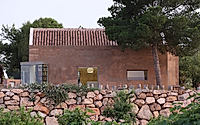
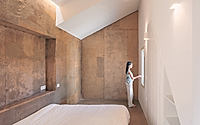
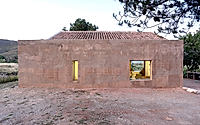
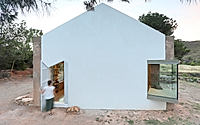
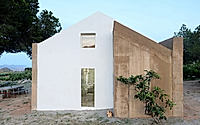
Low rural light catches thick walls and traces of old structure, pulling the eye from the ground up to the new volumes above. Inside, reused timber, exposed construction, and a generous main room register both age and renewal in a single glance.
This house in Paraje los Llanos, TM Lorca, Murcia, Spain takes shape as a rural dwelling rebuilt from a near-ruined childhood home. Pepa Díaz Arquitecta steers the project through Spain’s Architecture Quality Law, aligning restoration with a broad view of sustainability. The work favors adaptive reuse and careful intervention, treating the existing fabric as a resource rather than a relic.
Reworking A Near-Ruin
Very little of the original farmhouse survives, yet what remains anchors the project in memory and place. The new house grows from partial restoration, reinforcing existing structure while stripping away what can’t endure, so the rebuilt volume still reads as a continuation of the old home rather than a replacement. Emotional weight drives many decisions, tying the architecture back to the client’s childhood and the work once carried out on this land.
Local Ground, Local Matter
Sustainability here rests on more than energy metrics; it leans on environmental, economic, and social dimensions bound to the rural context. Local materials take precedence, and semi-buried walls use the site’s own soil, turning excavation into experimentation with the ground’s physical limits and strengths. That gesture shortens supply lines and deepens the architectural link to the terrain, while the client’s direct involvement mirrors the agricultural care once given to these fields. Rural architecture gains renewed dignity through this measured, hands-on construction.
Old Elements, New Roles
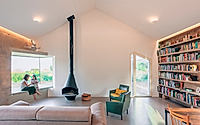
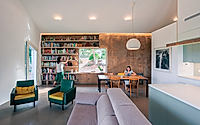
Fragments of the original roof and other salvaged parts move indoors, where they take on unexpected jobs in daily life. Timber boards once sheltering a stable now line walls as shelving in the contemporary living room, carrying age, texture, and family memory into the foreground. This kind of reuse turns demolition into selective harvesting—each kept piece records a previous cycle of occupation while supporting the present one. The interior gains depth without resorting to nostalgic replicas or decorative pastiche.
Recasting Rural Domestic Life
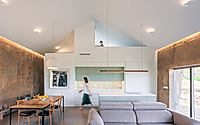
The former plan, sliced into small rooms, gives way to a large principal volume defined primarily by its structure and absence of suspended ceilings. This expansive core compresses the rest of the program into a more compact block of bedrooms and bathroom, so daily routines flow through one shared zone rather than a corridor of closed doors. The move breaks with the domestic model of the 1960s and ’70s yet stays grounded in rural life, supporting communal gathering while retaining quieter corners for rest.
Continuity Across Generations
By restoring a working farmhouse type for contemporary living, the project argues for the ongoing value of rural architecture, often dismissed as obsolete. The rebuilt home protects its occupants from urban expansion, not by retreating into nostalgia but by maintaining an active relationship with ancestral land. Children move through rooms shaped by their grandparents’ labor, and the house becomes a physical ledger of those efforts. Memory stays tangible, ready to be read by future generations.
Late in the day, shadows settle into the semi-buried walls and the reused timber grows darker against the whitewashed surfaces. The house holds that quiet, connecting past labor, present routines, and future inhabitation in one continuous rural story. It stands as a measured answer to how we might keep living in places already marked by family and work.
Photography by Juan S. Calventus
Visit Pepa Díaz Arquitecta