Résidence l’Échouage by Bourgeois / Lechasseur architectes
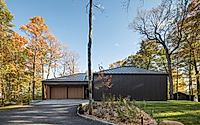
Résidence l’Échouage sits on a narrow point of land in Saint-Augustin-de-Desmaures, Canada, where the St. Lawrence River presses close on both sides. Bourgeois / Lechasseur architectes transform an inherited summer house into a cedar-clad residence of linked pavilions, balancing resilience with an intimate relationship to the shifting tides. The project reads as a modest house from the ground yet quietly extends into a layered landscape of rooms, courtyards, and river views.


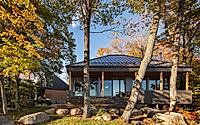
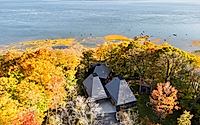
Low tide reveals sand, rock, and the long reach of the St. Lawrence River, with a timber volume poised just above the shifting line of water. As the wind moves through the surrounding maples and the tide slowly returns, a cluster of cedar-clad forms reads as one restrained house from the shore, only revealing its full composition when traced from pavilion to pavilion.
This project is a house in Saint-Augustin-de-Desmaures, Canada, conceived by Bourgeois / Lechasseur architectes as a riverside residence built in dialogue with tidal rhythms. The designers keep an existing summer cottage rooted above the water while extending it through carefully placed pavilions that respect setbacks and rising levels. Context drives every move, from the fragmented layout within the buildable zone to the courtyards carved between volumes for light, shelter, and river air.
Working With The Shoreline
The house occupies a narrow point of land bordered by two sandy bays, with erratic boulders scattered where the tide has long receded and returned. Instead of pushing a single volume across the site, the team accepts regulatory lines, setbacks, and water level limits as a framework that shapes the plan. Distinct pavilions sit within the permitted zone while the original cottage holds its grandfathered perch above the river, so the ensemble meets rules without losing that precarious intimacy with the water.
Preserving The Cottage
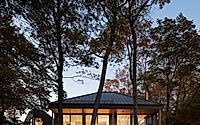
The commission begins as a call to demolish a modest summer house and replace it with a new build. That plan changes during the first site visit, when the cottage’s covered terrace, simple outline, and taut relationship to the horizon prove too valuable to discard. The structure is carefully lifted to install new piles, floors and roof are reinforced, and the envelope is fully insulated, so the old shell now stands higher, more resilient against fluctuating tides while still hovering close to the river.
Sequencing Pavilions And Courtyards
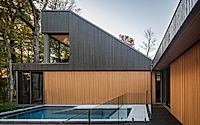
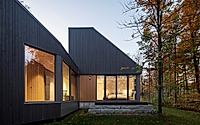
Life in the house unfolds as a sequence of linked rooms oriented toward water and light rather than a single central hall. The original cottage holds the main living areas, fully turned toward the St. Lawrence and washed with daylight, while an east pavilion rotates slightly to draw in the morning sun for the primary bedroom set apart from communal life. A third volume hosts an accessory dwelling unit for the clients’ parents toward the western bay, and together these offset forms generate two distinct outdoor courts: an arrival court that gathers both front doors, and a western inner court that shelters a swimming pool from prevailing winds. The result is an intimate, sunlit outdoor room with river views, positioned where regulations allow and screened from interior rooms.
Framing River And Light
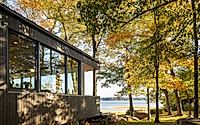
Inside, movement between the pavilions becomes a slow reveal of the surrounding landscape, with each opening cut to capture a different aspect of river, bay, or tree line. A bridge spans above the protected setback and forms a moment of suspension between new construction and the restored cottage, turning a regulatory limit into a spatial pause. Existing wooden structure in the living areas stays legible and is reinterpreted through a contemporary lens, so memory and new work sit in direct conversation.
Cedar As Coastal Skin
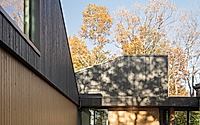
Materiality grounds the project in its maritime context while expressing the broken-down massing of the house. All volumes wear cedar siding, but in two tones that give depth to the composition: darker cedar wraps primary exterior walls and recalls wood burnished by time, echoing weathered buildings along the river and the worn tones of nearby driftwood. Lighter cedar traces recesses, cutouts, and sheltered pockets, sharpening the sense of carved volumes and thicker facades, then continues inside to reinforce transparency and pull the eye toward the river. That consistent material band links exterior courts, bridge, and interior rooms, so the occupant’s path tracks tide, light, and shoreline rather than a conventional corridor.
As the tide swings and wind shifts across the two bays, the house stays low, fragmented, and steady against the water’s edge. From the river, it still reads as a modest cottage above the shore, though close inspection reveals a more complex family arrangement woven into the landscape. The project rests lightly on its point of land yet remains firmly tuned to the movements and constraints that define this stretch of the St. Lawrence.
Photography by Adrien Williams
Visit Bourgeois / Lechasseur architectes