Casa Viale Della Tecnica: Refined Roman Apartment
Casa Viale Della Tecnica sits in Rome’s E.U.R. district, where Maria Adele Savioli Architettura reworks a rationalist-era apartment into a contemporary, finely tuned residence. The 160-square-metre home unfolds around existing concrete and Venetian floors, setting a calm backdrop for custom furniture, crafted surfaces, and a renewed relationship between interior rooms and the wraparound terrace. Everyday life anchors the project, yet the material decisions push it into a richer, more considered register.


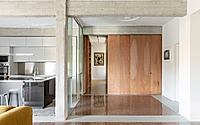
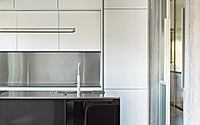
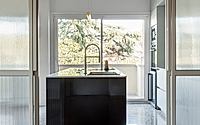
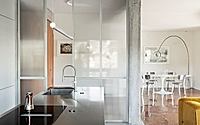
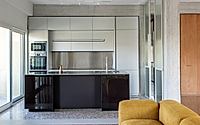
Light slides across Venetian flooring as it moves from terrace to living room, catching the rough grain of exposed reinforced concrete and the softer touch of wood. Every surface feels deliberate, from the brushed metals in the kitchen to the powder blue corridor that draws the eye toward the quieter rooms beyond.
This apartment in Rome’s historic rationalist E.U.R. district is reworked by Maria Adele Savioli Architettura as a contemporary residence rooted in existing material bones and fine-grained interior craft. The 160-square-metre layout shifts around Venetian floors and exposed structural concrete, using them as graphic and tactile anchors for a renewed domestic setting that privileges continuity, custom furnishings, and a calm dialogue between interior and terrace.
Material Bones Recast
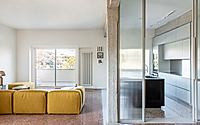
Venetian flooring and reinforced concrete walls do not sit as relics; they drive the composition and set the rhythm for every subsequent intervention. The renovation leans into their graphic potential, using variations in tone and texture to guide how rooms connect and how thresholds read underfoot. Openings expand toward the wraparound terrace, so the original materials carry light differently over the day and reinforce the sense of an apartment stretched between interior core and outdoor edge.
Living Core Assembled
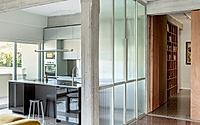
At the center, the living area works as one continuous volume, its exposed ceiling beams tracing visual lines that loosely frame seating, dining, and circulation. A glazed partition system draws a clear edge to the kitchen and entrance while preserving sightlines, so steel and brushed aluminium surfaces remain visible yet do not overpower the room. In this zone, natural materials hold the balance: the cool precision of metal meets the warmer grain of okoumé wood, which shapes a large furnishing volume and quietly separates living from sleeping quarters.
Tailored Volume And Color
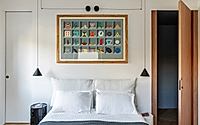
A multifunctional architectural volume sits just off the living area and works as the project’s hinge, organizing wardrobes, bookcase, and study into one coherent element. Within this built volume, storage pockets and work surfaces emerge with minimal ornament, so the object reads as architecture first and cabinetry second. Moving through it, a corridor in a gentle powder blue tone gathers the private rooms, softening the transition from active zones to quieter quarters with color rather than heavy doors.
Crafted Pieces In Dialogue
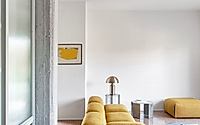
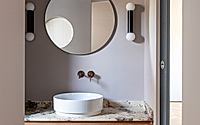
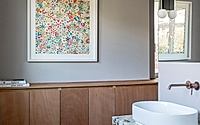
Throughout the apartment, built-in furnishings and doors are custom-designed and handcrafted, tying their proportions to beams, mullions, and structural grids for a consistent visual order. The living room grounds this approach with Salto Basso, a MAS Design table by Maria Adele Savioli, cast from sand, cement, and water with brushed aluminium detailing. Its pale, textured surface picks up tones from the floor and nearby finishes, while the sculptural base holds its own within the open-plan living room without disturbing the gentle material balance. Every component, whether concealed within the tailored volume or visible as a central object, contributes to an interior that reads as precise, quiet, and materially grounded.
Toward the terrace, light sharpens the contrast between concrete, Venetian aggregate, and the more delicate joinery, reminding the resident of the building’s rationalist origins. The apartment now holds that structural clarity alongside a layered interior palette, giving daily routines a setting that feels both robust and carefully tuned.
Photography by Eller studio
Visit Maria Adele Savioli Architettura