Entrelomas by V Taller
Entrelomas anchors a single-family house in Zapopan, Mexico, where V Taller answers dense urban conditions with an inward-looking concrete shell and garden-centered life. Behind the closed street façade, the project arranges social and private rooms around patios and a central courtyard, turning everyday routines for a young couple into a measured rhythm of light, shadow, and quiet air.


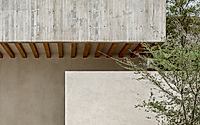
Concrete walls catch the street light and hold it, casting a quiet gray plane against the dense fabric around. Step past the closed façade and the mood shifts, as patios, gardens, and long structural lines pull attention inward.
This house in Zapopan, Mexico, is a single-family residence conceived by V Taller for a young couple who live within a tightly packed urban neighborhood. The project responds to noise, heat, and close neighbors through a calm interior world anchored by exposed concrete structure and a series of planted courtyards. Every move works toward a single aim: to build a robust, low-maintenance home that tempers climate, filters sound, and maintains a steady dialogue between construction and garden.
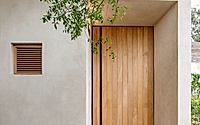
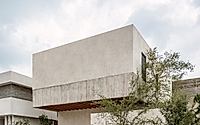
On the street, the volume stays restrained, almost mute. A closed façade of exposed concrete acts as both acoustic shield and visual filter, limiting direct contact with traffic while still allowing controlled views out. Fewer openings on unfavorable orientations improve thermal performance, so the envelope works like a thick coat rather than a thin screen. Behind that first layer, the house turns its attention inward, where air, shade, and vegetation take over as primary companions.
Concrete Shell And Core
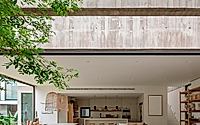
Structure and finish collapse into one system. Exposed concrete walls and beams carry loads, define rooms, and become the visual backbone of daily life. A single longitudinal beam reads as the project’s spine, running along the main axis, supporting the roof, and quietly marking transitions between social and private zones. By leaving the material honest and uncovered, the house gains a consistent texture and a sense of durability that matches its urban setting.
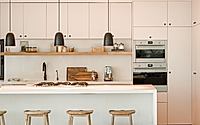
Carpentry in neutral tones and steel details sit against the concrete, not competing with it. This restrained palette keeps attention on proportion, light, and the grain of the formwork rather than on decorative layers. Surfaces need little upkeep, so maintenance stays low while thermal mass helps smooth out temperature swings across the day. The result is a construction logic that grounds the home and reinforces its promise of long-term, resilient living.
Ground Level With Garden Air
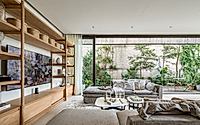
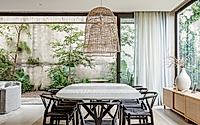
On the ground floor, social rooms align along the rear garden. Living, dining, and related areas share an open-plan configuration, allowing uninterrupted views toward vegetation and easy movement between activities. Large sliding openings pull back along this edge, turning walls into broad apertures that bring cross ventilation through the house. With this move, natural light and air become everyday utilities, reducing reliance on mechanical systems.
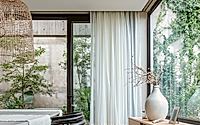
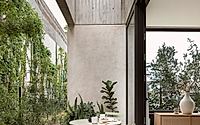
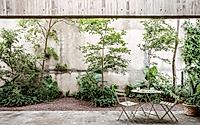
Patios and inner gardens punctuate the plan, creating a series of outdoor pockets just a few steps from the main rooms. These planted voids soften the hardness of concrete, while their positions help draw breezes and modulate sun. As people walk from one zone to another, the constant presence of gravel, foliage, and shifting shadows keeps the ground level feeling connected to climate rather than sealed from it.
Upper Courtyard For Privacy
Above, bedrooms arrange themselves around a central courtyard that functions as a green lung. This internal garden brings zenithal light into the upper level, brightening circulation and washing room thresholds with daylight. Each bedroom maintains its privacy through controlled openings, while the shared courtyard keeps a visual thread between them. The result is separation without isolation, as views slide across leaves and sky instead of facing neighboring walls.
The courtyard also supports climate control, letting hot air move upward and out while cooler air circulates below. Overhangs and selected vegetation add another layer of solar control, filtering direct sun and softening glare. For the residents, daily routines play out along short routes that cross air, shade, and concrete in quick sequence, reinforcing the sense of an inward, protected realm.
Measured Sustainability In Use
Passive strategies guide the technical choices more than gadgets do. Orientation, controlled openings, cross ventilation, interior patios, and vegetated edges work together to fine-tune thermal and lighting behavior. Even without formal certifications, the house leans on the mass of concrete, the placement of gardens, and the depth of overhangs to improve comfort over time. Vegetation chosen for resilience and low water demand keeps irrigation modest, reinforcing a pragmatic approach to resource use.
In daily life, the couple moves through a calm setting shaped by these decisions. Concrete, steel, wood, and planting keep their clear roles yet remain in constant conversation with the noisy city outside. At the end of each day, the street gives way to thick walls, filtered light, and the quiet presence of courtyards, reminding inhabitants that careful building can still carve out measured refuge within dense urban ground.
Photography by V Taller
Visit V Taller