LH Residence by Side FX Arquitectura
LH Residence sits in the Metropolitan District of Quito, Pichincha, Ecuador, as a single-family house by Side FX Arquitectura that treats density as a design prompt. The architects work between party walls and neighboring roofs to stage a gradual retreat from the street, drawing residents inward through courtyards and filtered thresholds until daily life settles around vegetation, daylight, and controlled privacy rather than the surrounding urban crush.


A narrow side passage draws visitors off the street, where planted borders tighten the route before releasing it into a courtyard framed by glass and wood. Light and foliage slip between volumes so the city’s density fades, replaced by filtered views and a sense of depth that unfolds one room at a time.
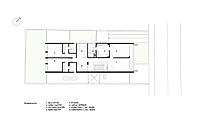
This single-family house in the urban heart of Cumbayá, part of the Metropolitan District of Quito, is conceived by Side FX Arquitectura as an introverted home that leans on sequence rather than scenery. Between party walls and neighboring roofs, the plan orchestrates a chain of courtyards, passages, and terraces that guide residents from the city toward a quieter interior life. Movement, compression, and expansion become the core tools that keep nature and daylight present despite the saturated context.
Arriving Through Thresholds
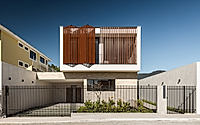
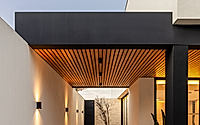
Arrival begins at the side passage that slips away from the street, deliberately breaking the usual frontal entry and signaling a shift in pace. Vegetation lines this path, turning the route into a green threshold where leaves, shadow, and narrow proportions slow the body before the front door. The entrance point itself contracts, almost like a pause in the sequence, then releases into a larger interior volume that immediately distances daily life from the sidewalk.
On crossing that line, residents move from exposure to a controlled interior landscape, with the first courtyard already in play as a visual anchor. The house doesn’t rely on distant views; instead, it choreographs short, repeated encounters with planted patios that keep nature present at every turn.
Ground Floor As Continuum
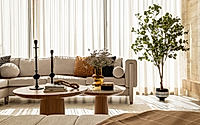
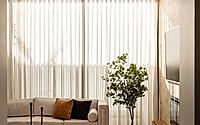
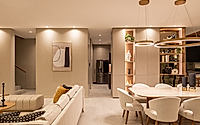
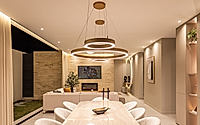
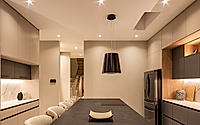
The ground level reads as a single flowing room where living, dining, and kitchen areas share one continuous floor and ceiling plane. Large glass panels open toward both the side and rear courtyards, so social life stretches crosswise between planted edges rather than facing the street. When those panes slide back, the main room becomes a long, airy volume framed by greenery on two sides.
A pergola marks the shift from interior to rear courtyard, casting filtered shadows that temper the equatorial sun and extending daily routines outdoors. This covered intermediate zone supports thermal comfort, turning the courtyard into a usable room that works as an extension of gatherings, quiet reading, or children’s play. Horizontal movement from kitchen to garden passes effortlessly through this shaded band, reinforcing the idea of domestic life strung along courtyards.
Light Wells And Upper Rooms
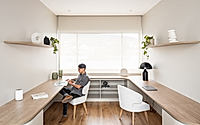
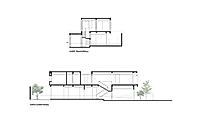
On the upper floor, the sequence shifts from horizontal traverse to vertical connection, with an internal courtyard acting as a light well for the family room and adjacent office. Zenithal light drops through this void, animating walls and floors while leaving the rooms protected from surrounding windows and rooftops. A fragment of sky becomes the primary view, a deliberate counterpoint to the lack of distant greenery at this level.
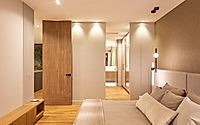
Children’s bedrooms turn toward the rear courtyard, capturing cross ventilation and steady natural light while avoiding direct views into neighboring houses. Daylight and airflow structure daily routines: morning light softens waking, and evening breezes pass through sleeping areas without relying on large, exposed openings. Every private room aligns with a quiet court rather than the street, sustaining the sense of refuge.
Facade As Living Filter
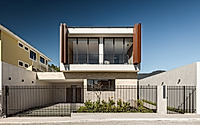
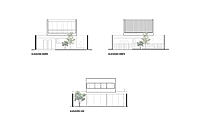
Toward the street, the upper-level terrace introduces a different kind of sequence, framed by movable lattices described as a living shutter. These panels slide and pivot to adjust privacy, sunlight, and views from the master bedroom and family room, shifting the facade from closed to porous throughout the day. The street-facing elevation becomes active, responding to the rhythms of its occupants instead of presenting a fixed mask.
Behind this adjustable screen, interior life extends outward without surrendering control to passersby or adjacent houses. Rooms borrow light and air from the terrace, gaining a buffer zone that mediates climate, noise, and sightlines in one compact band.
Courtyards Organizing Daily Life
Across the house, courtyards operate as the main organizers of circulation rather than leftover voids. They function as small climatic lungs that cool, ventilate, and visually center each cluster of rooms. Family activities gather around these planted cores, from ground-floor meals surrounded by greenery to quiet work beside the upper light court.
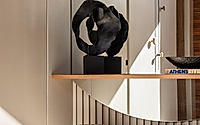
Material choices reinforce this inward focus: wood surfaces on facade and interior elements bring tactile warmth, while metal and travertine give structure and grounding texture. Wall colors lean toward warm tones that support a calm domestic rhythm, aligning with neuroarchitecture principles that prioritize sensory and psychological wellbeing. Movement through the house becomes a chain of distinct yet related experiences—compressed passages, luminous voids, planted courts—that steadily buffer the pressures of urban density.
In the end, daily life here plays out around courtyards and controlled openings instead of outward views. Light, air, and vegetation carry through the plan, giving each level a clear relationship to nature despite its tight plot. Within its party-wall setting, the house turns inward with intention, using sequence and section to construct a measured, contemplative domestic world.
Photography courtesy of Side FX Arquitectura
Visit Side FX Arquitectura