Winkelhaus — Curved Family Home Rooted in Swiss Hillside Landscape
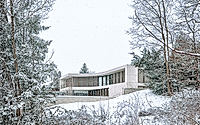
Winkelhaus sets a curved concrete silhouette against the forested edge of Winkel, Switzerland, aligning every room with valley views. Estúdio KMMK shapes this single-family house as a quiet study in structure, material, and landscape, drawing on local stone and bronze details. The project balances a raw exterior expression with a restrained interior world, where white surfaces and pale timber keep attention on changing light throughout the year.


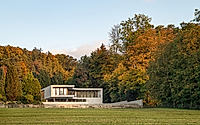
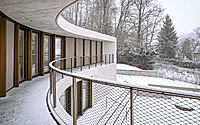
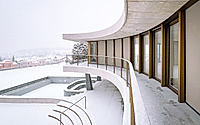
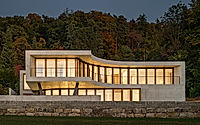
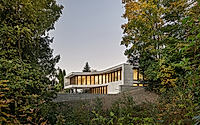
Low light catches the textured bronze windows as the curved façade tracks the forest edge, concrete softening into garden and grass. From the terrace, the valley drops away in a broad arc, and every room turns toward this horizon of trees and distant roofs.
This single-family house in Winkel, Switzerland, is the first work by Estúdio KMMK in the country and a clear statement about structure and making. The project hinges on a concrete shell that bends toward the landscape, tying interior life to the adjacent forest and open valley. Material choices inside and out grow from that shell, from hand-worked stone in the garden to the quiet, pale surfaces within.
Shaping The Curved Form
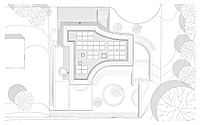
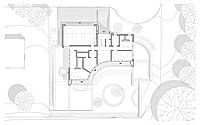
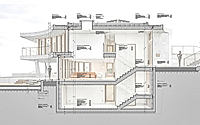
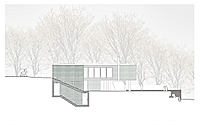
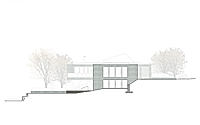
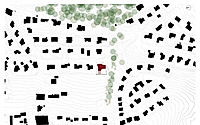
The house follows a gentle curve that keeps every primary room facing the landscape rather than the street. This arc gathers the family along one continuous outlook, so daily routines track the same long view through shifting weather and seasons. Structure and orientation merge in a concrete body that resists the slope, holds back the garden, and anchors the building to its hillside. That gesture turns a simple plan into a radial sequence of rooms, each slightly offset yet bound by the same outer sweep.
Concrete, Bronze, And Stone
Raw concrete is not treated as a blank backdrop; it is the primary exterior material, exposed to rain, frost, and filtered forest light. Textured bronze windows sit inside this frame, their patina catching warm tones that echo the autumn canopy and shifting sky. Around the base, hand-worked stone slabs extend from the structure into the garden, connecting the house to local Roman ruins and the layered history beneath the town. The result is a sturdy, tactile ensemble where every joint, edge, and opening is tuned for material precision rather than surface effect.
Interior Restraint, Exterior Focus
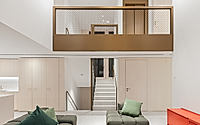
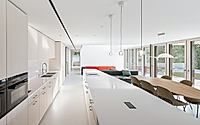
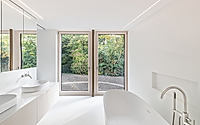
Inside, the palette turns almost monochrome to push attention outward toward the forest and valley. White floors, white-washed natural wood, and plastered walls and ceilings create a calm, even light that runs through the curved plan. Furniture and built-in elements sit quietly against this pale shell, allowing the changing greens, golds, and winter grays outside to supply color. The contrast between the robust exterior and the pared-back interior gives daily routines a clear rhythm, moving from rougher textures at the garden edge into smoother surfaces at the heart of the house.
Craft, Technology, And Energy
An extended team of engineers, landscape architects, lighting specialists, and digital fabrication researchers works with Estúdio KMMK from the first sketches. That collaboration shapes everything from the handling of stone to the performance of glazing and the layout of services. Geothermal and solar systems pair with a passive architectural strategy, so the building mass, orientation, and openings reduce energy demand before technology steps in. Digital fabrication methods, developed with ETH Zurich, guide specific elements such as a 3D-printed formwork for the outdoor kitchen, where concrete once again becomes both structure and surface.
Garden As Extension Of Structure
The garden is planned as an extension of the concrete frame rather than a separate layer applied at the end. Terraces, planted areas, and outdoor rooms slip between structural walls, so private exterior corners feel threaded into the hillside and forest edge. Over time, vegetation grows against the concrete and stone, softening the joints but leaving the primary curve legible from above and below. By completion in 2026, house and landscape together read as one continuous band along the slope.
Toward evening, shadows from the forest lengthen across the white floors while bronze window reveals hold the last warm light. The building reads as both new and grounded, its concrete, stone, and metal patiently taking on weather and time. Within that frame, the restrained interior leaves room for the surrounding valley to do the daily work of change.
Photography by archibatch, fredemontanha
Visit Estúdio KMMK