Inverted House by TIMM
Inverted House rethinks suburban living on the hillside of Tbilisi, Georgia, where TIMM confronts a neighborhood of fences by turning the dwelling inward. The single-family house in Okrokana replaces the conventional boundary wall with inhabitable architecture, shaping daily life around two gardens rather than distant views. Within this protective perimeter, light, proportion, and a calibrated use of wood and white surfaces set the tone for calm, introverted domesticity.
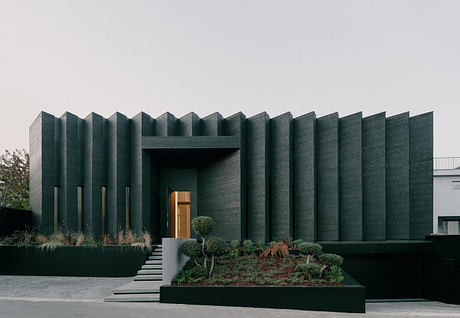
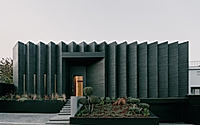
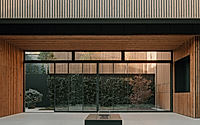
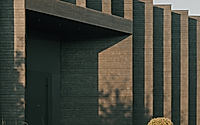
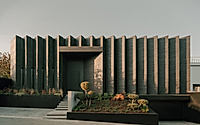
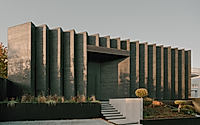
From the narrow street, a dark timber volume pulls back just enough to form a shallow forecourt. Light slips over the recessed facade, hinting at a world tucked behind its charred surface. Step past the threshold and the city’s noise falls away; the house redirects attention inward, toward planted ground and pale walls catching the sky.
This single-family house in Okrokana, on Tbilisi’s hillside edge, responds to a district where fences dominate more than views. TIMM treats those constraints not as background conditions but as raw material, reimagining enclosure as habitable perimeter. The project concentrates on how a protective outer shell, a softer courtyard ring, and a pale interior work together to recast domestic life around an inner horizon.
Instead of placing a compact volume behind a separate wall, the building stretches along the property boundary and becomes the fence. Rooms and terraces track the edges of the plot, enclosing an internal void that reads as open-air hall rather than backyard. Along the street, the volume steps slightly back, trimming the hard line between sidewalk and threshold and creating a shallower zone that mediates everyday arrivals.
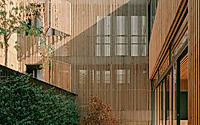
Two gardens structure what happens on either side of this inhabited perimeter. Toward the street, the outer garden negotiates visibility and distance, allowing the low front volume to sit in green rather than in raw asphalt. Inside, the courtyard becomes the true center of the house, a planted floor ringed by glass and white planes where daily routines turn toward light instead of toward neighboring walls.
Courtyard Frames Daily Life
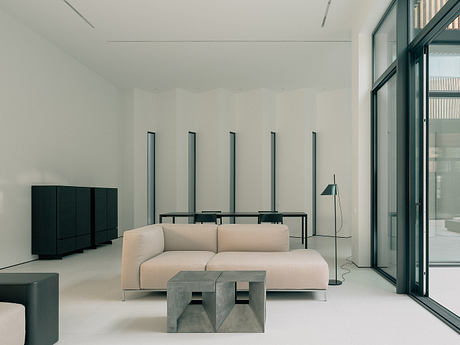
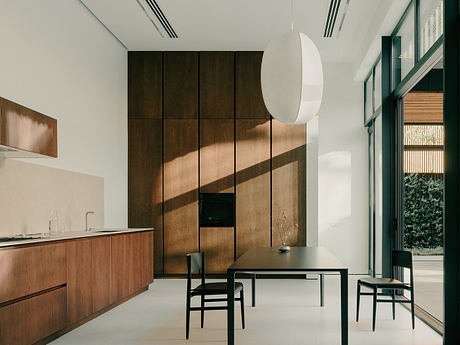
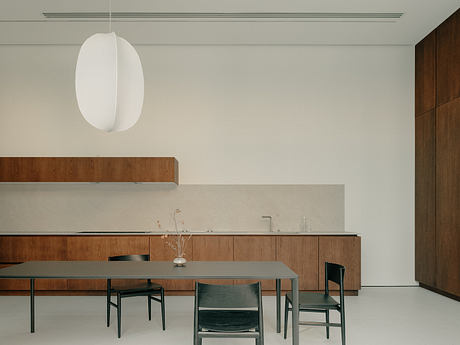
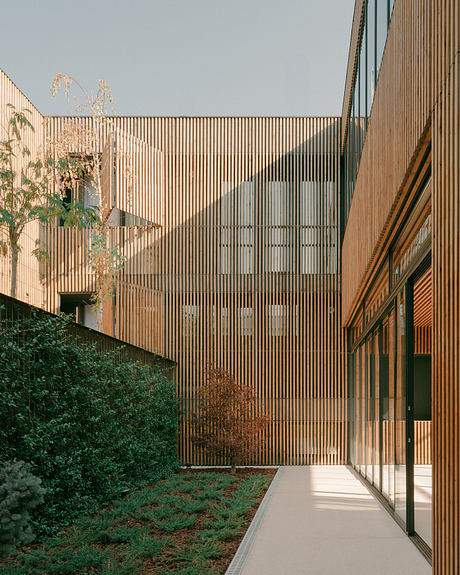
Entrance hall, living room, and kitchen align along the inner edge so every main room addresses the courtyard directly. The courtyard reads almost as another room, only roofless, pulling daylight deep into the plan and giving each level a consistent focus. A suspended swimming pool spans the void above part of this planted center, shading an outdoor area below while stitching upper floors together in section.
At the back of the plot, the perimeter wall grows into a three-story volume that holds more private rooms. Toward the street, the mass drops to a single level, keeping the urban frontage low and compressed. This sectional shift allows a double-height living area and a series of half-levels, so movement through the house feels like a slow climb along the perimeter, with the courtyard always in orbit.
Shell, Garden, Core
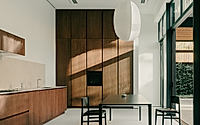
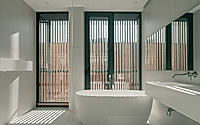
Material transitions reinforce the project’s inversion of inside and outside. Street-facing surfaces are clad in charred wood, using a traditional weatherproofing technique to establish a dense, almost armored shell. Around the courtyard, that dark cladding gives way to natural timber, where grain, color, and texture draw people closer and soften the enclosing ring.
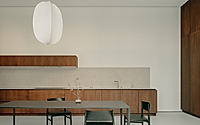
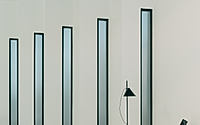
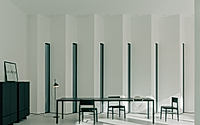
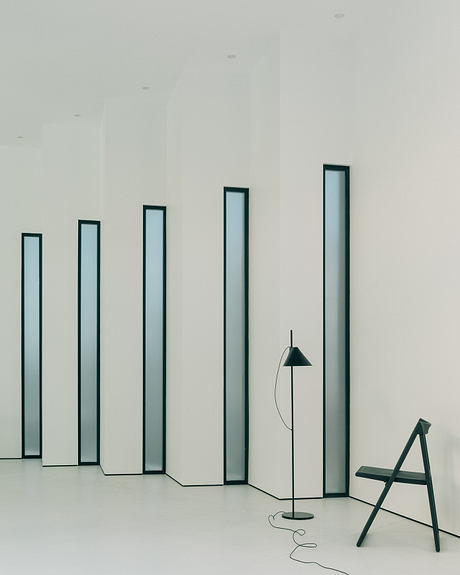
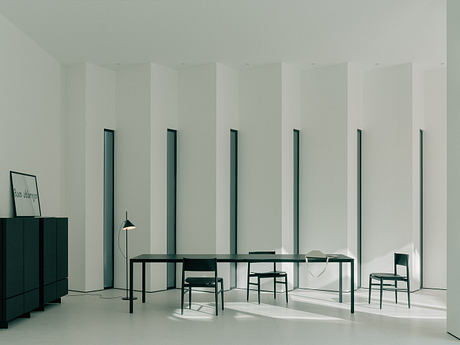
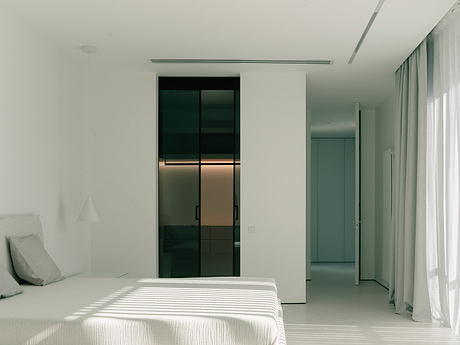
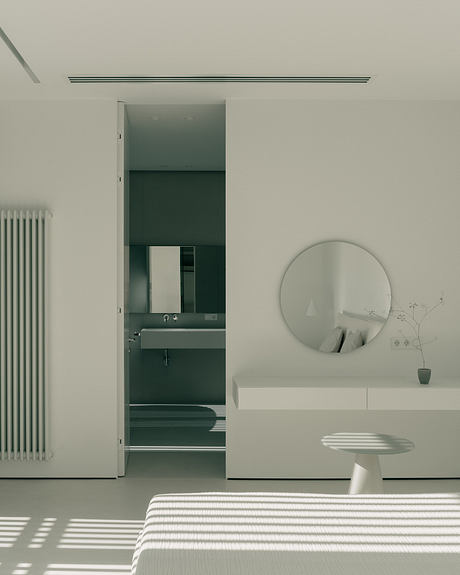
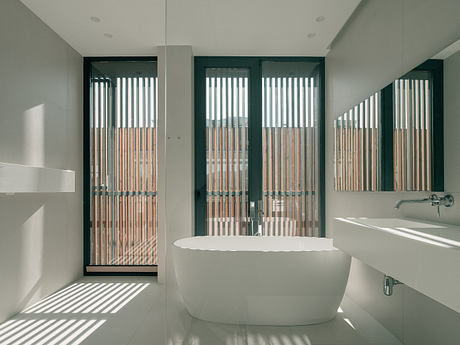
Crossing from garden ring to interior core, the palette turns entirely white. Walls, ceilings, and built-in elements recede into this pale field, allowing light, shadow, and proportion to define each room’s character. The effect is not decorative; it sharpens awareness of the courtyard greenery, the warm timber thresholds, and the deep-black exterior shell that holds everything together.
Working With Enclosure
Okrokana’s narrow streets and tall fences often compress everyday experience into thin strips of yard and interior. Here, that same culture of enclosure is turned on its head and folded into the project’s structure. The perimeter stops being a line to hide behind and becomes a lived edge, thickened with rooms, terraces, and bridges.
By absorbing the fence into the building mass, the house transforms a plot without outward views into a place oriented around its own inner world. In this setting, enclosure is no longer a defensive reflex but a calibrated tool: it gathers family life inward, controls exposure, and lets a carefully layered palette build depth from street to courtyard to room.
As day moves over the hillside, the charred shell darkens in shadow while the inner timber and white volumes brighten. The project sits firmly within its walled neighborhood yet proposes another way to inhabit such density. Privacy is maintained, but the inner gardens and calibrated materials keep the daily experience open, luminous, and quietly expansive.
Photography by Grigory Sokolinsky
Visit TIMM