AGR House: Climate-Open Concrete Home with Lush Urban Courtyard
AGR House sets a quiet yet assertive presence in Bintaro, South Jakarta, Indonesia, where DSI Architect shapes a house around climate and daily rhythm. The residence uses split-levels, terraces, and a warm interior palette to tune movement, light, and landscape to the tropical setting. Within this layered arrangement, rooms shift between retreat and sociable gathering, reflecting an owner whose routines favor solitude yet still welcome structured moments of connection.


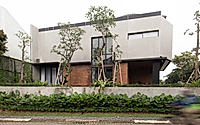
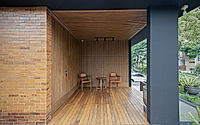
Light catches the edges of bare concrete and exposed brick as the house steps gently down its split levels. A terrace sits between greenery and facade, holding both formal greeting and relaxed conversation in the same open air.
AGR House is a house in Bintaro, South Jakarta, Indonesia, designed by DSI Architect around movement, climate, and the changing character of tropical light. The project treats the dwelling as a dynamic entity, where split-level transitions guide daily routines and frame a close dialogue between interior rooms and surrounding landscape. At every turn, architecture stays tuned to weather, planting, and the owner’s preference for solitude punctuated by intentional social encounters.
Shaping Climate With Levels
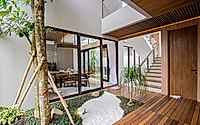
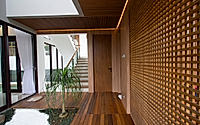
Each level grows from the rhythm of split-level circulation, so vertical shifts feel gradual rather than abrupt. Movement up or down becomes a way to register changing temperature, light intensity, and view. One landing might catch a breeze through an opening, while the next steps closer to a garden edge and its filtered shade. This layered section turns what could be a static volume into a sequence of micro-climates, tuned to different times of day and different habits.
Terrace As Threshold
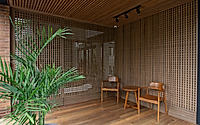
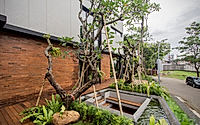
The terrace works as a deliberate threshold, not just a leftover slab in front of the door. Guests who stay briefly experience it as a formal forecourt, where the house signals its presence against the micro-environment. When visits stretch longer, a sunken outdoor living area draws people down into a more relaxed posture, closer to planting and breeze. This single outdoor room quietly shifts role with each encounter, holding both public welcome and informal lounging without changing its physical outline.
Material Frame For Greenery
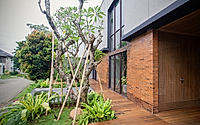
An imagined boundary arises from the mix of greenery and carefully chosen materials at the facade. Trees and planting extend the edge of the property outward, softening the line between street, garden, and house. Against this living layer, bare concrete and exposed brick create a calm, durable shell, with black-painted accents cutting sharper lines of depth and shadow. Subtle wooden elements introduce warmth without distraction, so foliage, sky, and texture carry most of the visual weight.
Inscape And Interior Warmth
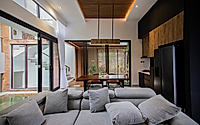
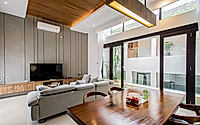
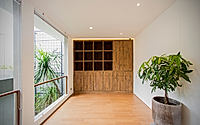
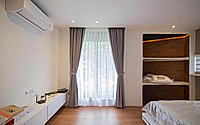
Inside, a warm palette and generous openings keep the tropical setting present rather than shut out. Daylight enters through broad apertures, then softens as it meets interior surfaces and planted views. Certain elements act as what the architect calls “inscape,” echoing outdoor greenery so the tropical character repeats within the house. This internal landscape deepens the sense of continuity, as if rooms sit inside a larger field of vegetation and light.
Routines, Privacy, And Presence
The house supports an owner whose routines lean toward solitary, independent rhythms. Rooms are arranged to protect privacy for daily exercise, work, and quiet reflection, yet they allow controlled openness when social occasions are planned. Honest construction and unembellished surfaces mirror that consistency, aligning the architecture with regular habits rather than spectacle. In this way, the residence becomes a steady marker in its neighborhood, grounded in climate, character, and the slow passage of everyday time.
As sun moves and weather shifts, the terrace, levels, and planted thresholds keep redrawing the edge between inside and out. Evening settles on the concrete and brick, while interior light meets the dimming garden without abrupt contrast. AGR House rests in that balance, an unvarnished frame for climate, routine, and a clear sense of belonging.
Photography courtesy of DSI Architect
Visit DSI Architect