Casa Colina Explores Arches, Stone, and Courtyard Living in Tulum
Casa Colina is a house in Tulum, Mexico, designed by Estudio Paulina Villa Arquitectura as a sequence of arched rooms, courtyards, and terraces that open directly to the landscape. Designed in 2025, the project turns the clients’ wish for clear indoor-outdoor living into an arrival experience with real presence, then carries that calm through living areas, bedrooms, and bathing rooms shaped in stone, plaster, wood, and filtered light.


About Casa Colina
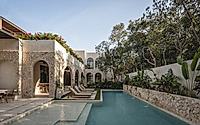
Arrival begins with stone and shadow. A rough masonry arcade runs beside the water, and the long pool draws the eye toward a calm inner court framed by trees and pale walls. The approach feels measured.
Casa Colina is a house in Tulum, Mexico, designed by Estudio Paulina Villa Arquitectura in 2025. The project grows from the idea of emergence, giving the building a grounded presence at entry before loosening its edges through openings, terraces, and rooms that stay closely tied to the exterior. Interior and garden remain near.
Move Along Water
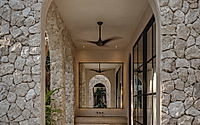
The first sequence runs parallel to the pool. Repeated arches, textured stone walls, and shallow steps create a steady rhythm, so movement happens in short episodes of sun, shade, reflection, and framed views. Planting softens the perimeter.
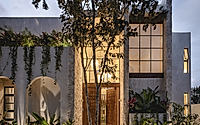
From the court, the house reveals its depth without giving everything away at once. Windows with dark metal frames punctuate the white upper volume, and the stair and entry sit behind a tall glazed opening that brings daylight deep into the center. The route stays clear.
Open The Living Room
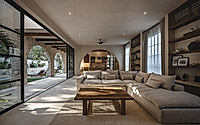
A large sliding glass wall pulls the main living area toward the terrace. Inside, a deep sectional, a low wood table, and built-in shelving hold the room close to the floor, while an arched opening and exposed beams guide the eye toward the kitchen beyond. Light does the rest.
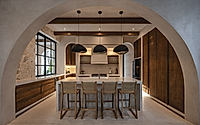
That kitchen continues the same sequence rather than breaking it. A broad island anchors the room, pendant lights hang low over woven stools, and wood cabinetry is set within curved plaster reveals that make storage, cooking, and circulation read as one continuous volume. Nothing feels abrupt.
Settle The Bedrooms
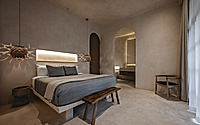
Private rooms keep the palette restrained. Plaster surfaces, arched doorways, sheer curtains, and wood pieces give the bedrooms a quiet weight, with concealed lighting cut into niches and headboards so the walls appear thick rather than thin. The mood stays low and even.
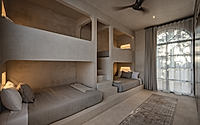
In the bunk room, the architecture becomes furniture. Beds are carved into the room as built-in recesses with rounded corners and small lit alcoves, turning a compact sleeping area into a calm composition of platforms, openings, and soft shadow. It feels close and practical.
Carve The Bath
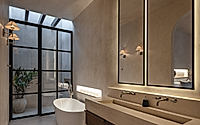
Bathrooms extend the same language with a slightly slower pace. A freestanding tub sits near a glazed wall and planted court, while a long stone vanity, twin mirrors, and a bed of rounded pebbles emphasize length, reflection, and the tactile contrast between smooth plaster and rougher ground. Water meets daylight here.
Even the smaller passage views are composed with care. Through an exterior arch, another basin appears at the end of a shaded corridor, showing how daily routines are folded into the larger procession of courtyards, walls, and framed openings. The house keeps unfolding.
By the end, the strongest impression is not a single room but the continuity between them. Stone, plaster, wood, water, and filtered light carry the house from arrival to rest, making the boundary between indoors and out feel thinner at every step. The sequence holds everything together.
Photography courtesy of Estudio Paulina Villa Arquitectura
Visit Estudio Paulina Villa Arquitectura