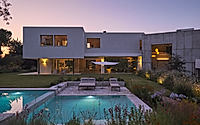
Arco House: A Madrid Home Shaped Around Art, Color, And Garden
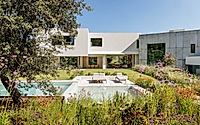
Arco House is a house in Madrid, Spain, designed by ÁBATON for clients whose contemporary art collection shaped the brief from the outset. Completed in 2024, the project arranges public rooms, family areas, and a more private suite within one continuous approach to architecture, interiors, and landscape. Color, framed garden views, and open connections to the outdoors guide the experience throughout.


About Arco House
Casa ARCO is one of the studio’s most distinctive recent works, shaped from the outset by a clear premise: to create a custom-made house for art.
Its owners, passionate collectors of contemporary art, approached architecture as an active part of the artistic and domestic life that defines how they live. The brief centered on a clear appreciation of beauty and on giving color a leading role.
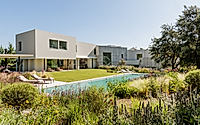
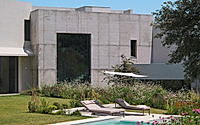
The project brings together architecture, interior design, and landscaping as a single language in service of art and connection. Casa ARCO is organized into two distinct zones—one more public, the other for family life—linked by a central core where the entrance is marked by a pivoting door. A stepped concrete staircase anchors this area, framed by a large window that turns the northern part of the garden into an ever-changing image.
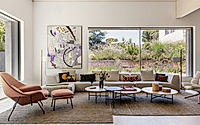
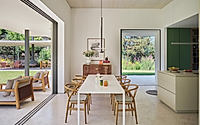
On the east side of the house, the rooms intended for guests unfold in a fluid sequence. The living room, dining room, and kitchen open fully to the outdoors through sliding windows, allowing this part of the house to work as a porch during the hotter months.
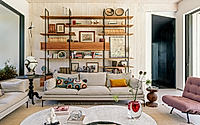
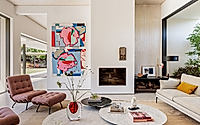
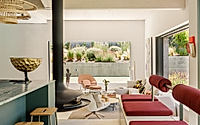
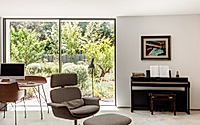
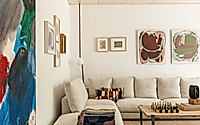
In the living room, the southern and northern views are defined by the color of the landscaping, setting up a continuous exchange between the garden, the interior pieces, and the art. Costela armchairs by Tacchini and works such as Gemelares by Luis Gordillo stand out against an architectural setting marked by minimalism and exposed structural wood.
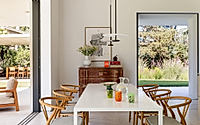
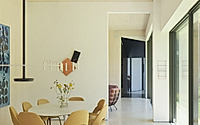
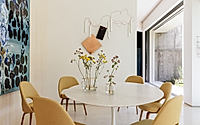
Color plays a central role in the dining room as well, conceived almost as an exhibition area. A large-format painting by Jose Luis Alexanco holds the room, balanced by the lighter presence of Davide Groppi’s Simbiosi lamp.
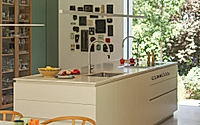
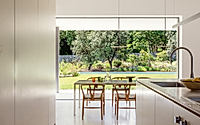
The kitchen, designed by ÁBATON, also works with color. Its layout is organized around a large island and connected to a semi-hidden service kitchen.
Nanimarquina rugs and exhibition pieces make this area carefully composed yet fully lived in, with direct contact to the southern part of the garden. Large windows disappear into the walls, establishing a direct relationship with the landscape and removing visual interruption.
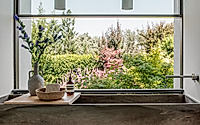
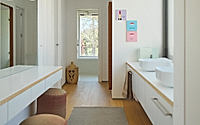
The transition to the more public wing is marked by a volume clad in sheet metal that leads to a minimalist toilet. Here, a cantilevered natural stone washbasin sits in front of a large window framing the landscaping. Even in circulation areas, the house pays close attention to the relationship between matter, light, and nature.
The west side contains the rooms for family use. A large continuous area is organized through changes in level that separate the kitchen, living room, and a singular room: a golf simulator that reflects another of the owners’ interests. From here there is direct access to the garden, where a miniature golf course is integrated into the landscaping.
The living room is set slightly into the terrain and surrounded by layered masses of planting that create an enveloping view of color and vegetation. Works such as a sculpture by Xavier Mascaró or Axuk by Juanjo Maillo establish a contemporary language alongside pieces such as the Bend-Sofa by Patricia Urquiola and the TMM lamp by Miguel Milá. A little higher up, an open kitchen with a marble countertop forms a more informal and relaxed area for family life.
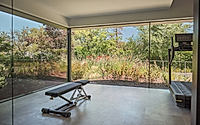
This part of the house also contains an office, a toilet, and a glazed gym set within the vegetation. The result is a more intimate zone that still remains open to the outdoors.
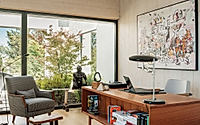
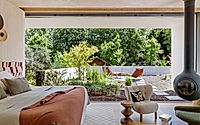
On the mezzanine between the main floor and the children’s level, a more private area contains the main suite and a second office. The intention was to create a separate zone for the couple, with its own connection to the exterior and a greater sense of privacy than in the rest of the house.
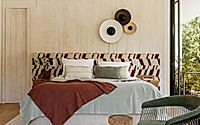
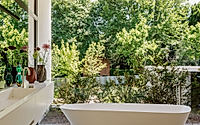
The bedroom opens onto a large garden terrace that extends the room outward. The bathroom, conceived as an open and luminous setting, combines shower and bathtub facing the garden, reinforcing a sense of intimacy in close contact with nature. Dressing room, bedroom, and terrace are linked as one continuous sequence.
Upstairs, two children’s bedrooms are reached through a shared living room conceived as a flexible area where art also has a place.
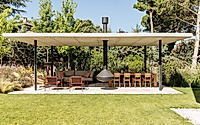
The garden pavilion was designed as an outdoor room for use throughout the year. With a fireplace and dining area, it allows life outdoors without giving up comfort in any season.
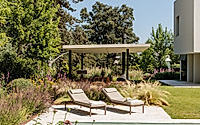
The landscape follows New Perennial principles, with a naturalistic composition based on grasses and perennials that shift with the seasons. The main meadow is set against looser masses of planting that bring texture, movement, and biodiversity, forming an ecosystem for birds and pollinating insects.
Paths run through the vegetation and invite movement across the garden, revealing different areas along the way: a pavilion with an outdoor dining area in direct contact with the landscape, a reading corner beneath a tree, and rest areas that merge naturally with their surroundings.
Here, the landscape is not treated as background but as a living extension of the architecture. The house opens toward the garden, is sheltered by it, and is framed through it.
ARCO House is the result of an integrated process in which architecture, interior design, and landscape form a quiet but expressive support for life and art. It is a home made for living, contemplation, and sharing, shaped by sustainable, conscious, and empathetic principles.
Photography courtesy of ÁBATON
Visit ÁBATON