Vortex 21 Raises Two Monumental Arches Over Betul
Vortex 21 stands in Betul, India, as a layered corporate headquarters by Neelesh Chopda Architecture that also folds in gathering spaces and family living. On a long plot running between two roads in the town center, the project treats the building as both workplace and public face, using section, facade, and garden to separate bustle from retreat.


About Vortex 21
Vortex 21 occupies a long central plot in Betul, extending from the main road to Hein Road and sitting beside residential buildings. Designed by Neelesh Chopda Architecture, the project brings together a corporate headquarters, spaces for public gathering, and a substantial residential component within one vertical composition.
What distinguishes the building is not simply its mixed program, but the way that program is stacked and edited. Public rooms, workspaces, service areas, parking, and animal shelters begin at ground level; offices and conference rooms continue on the mezzanine; a triple-height gathering hall sits above; and the upper levels shift toward garden, family living, bedrooms, and a terrace with leisure spaces.
A Vertical Sequence
The plan turns a relatively narrow urban site into a sequence of distinct zones. At the base, the ground floor keeps movement practical, accommodating parking, office functions, gathering areas, and a driveway that leads to the residential lobby. The mezzanine adds conference and office space, reinforcing the building’s working identity before the program opens upward into more ceremonial and domestic rooms.
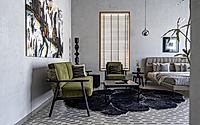
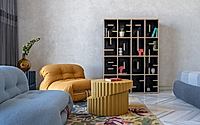
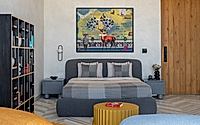
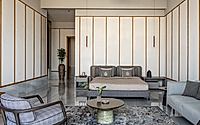
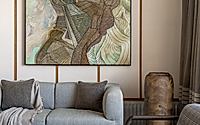
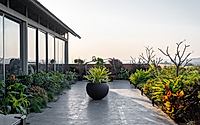
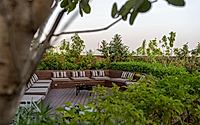
The first floor centers on a triple-height gathering hall, with guest rooms and services nearby. Above that, the second floor is treated as a garden slab, set roughly 12 m (39.4 ft) above the ground and carved with sunken areas for large trees and planting. A lift rises directly from the parking level to this elevated garden, where living, dining, and family rooms face greenery rather than the street. Bedrooms are placed above, while the terrace gathers a spa, gym, and snooker table into an outhouse-like retreat.
Facade as Frontage
Given its position in the town square, the facade is treated as a public statement. Two large arches set the building’s main image: one open and prominent for the gathering hall, the other recessed and shadowed at the residential entry. The gesture gives the frontage a civic scale while keeping the two realms legible from the street.
Locally sourced stone clads the lower portion, shifting in tone from gray to pink. Up to about 12 m (39.4 ft), the elevation reads as monolithic. Above that line, translucent marble panels take over, filtering sunlight and changing the building’s appearance through the day. The marble skin is set 10 ft (3 m) away from the structural slab, allowing light to pass through and giving the upper facade a lighter, more detached presence.
Light and Interior Finish
Performance drives much of the envelope strategy. The marble is described as non-porous, sound-insulating, and resistant to dust, while its translucence helps soften harsh east light. Openings on the northern side support breeze and cross-ventilation, an important adjustment for a building that rises above the surrounding 10 to 11 m town skyline.
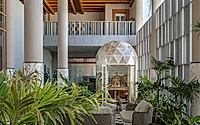
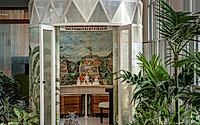
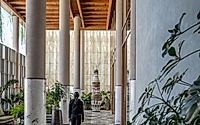
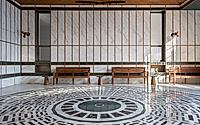
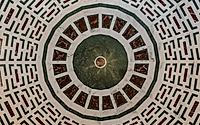
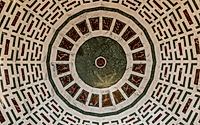
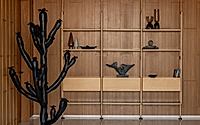
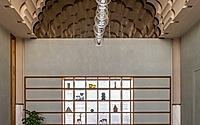
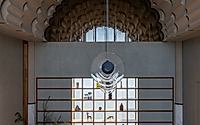
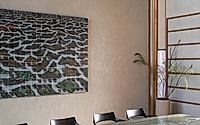
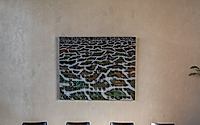
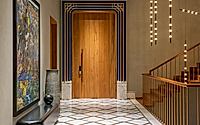
Inside the gathering hall, the material language turns more patterned and radial. Concentric gray and yellow Kota stone defines the floor, while a domed teakwood ceiling with marble inlays continues the circular geometry overhead. White marble walls, gray veining, teakwood slats, and a dark green marble band sharpen the room’s edges. A white marble mosaic floor with green and reddish-brown inlays extends the wave-like pattern across the space and into the stair, giving the hall a strong visual identity without abandoning the project’s restrained palette.
Vortex 21 works by separating intensity rather than uses alone. Work, assembly, garden, and domestic life each occupy their own level, while the facade gives that internal order a clear and memorable face in the center of town.
Photography by KUBER SHAH
Visit Neelesh Chopda Architecture