Rock Villa by Raad Group
Rock Villa stretches along the rocky terrain of Bumehen, Tehran, Iran, reading as an outgrowth of the mountain rather than a conventional house. Raad Group arranges the volumes with care, tucking rooms into the slope while letting upper levels lean toward the center of the site. The project uses landscape, light and reused materials to tie daily life to the climate that surrounds it.


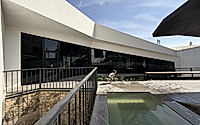
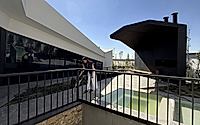
Approach cuts across raw stone and low planting before the house fully reveals itself. From this angle, stepped volumes fold into the mountain and hold a measured line against the sky.
This is a house, but it reads as terrain. Rock Villa in Bumehen, on the outskirts of Tehran, threads its rooms along the slope so that shelter grows out of geology. Raad Group works with the mountain’s contours, using ground, light and prevailing breezes as active tools. The project favors ecological continuity and climate response over objecthood.
Excavation stays minimal, and lower levels nestle into the rock rather than sit on a cleared plateau. Ancient stone remains visible on interior surfaces, so a resident moving through a corridor is always in contact with the mountain’s texture. Upper floors rest more lightly and lean inward toward the site’s center, producing a quiet silhouette that tracks the surrounding topography. Architecture and hillside read as one terrain with varied depth.
Shaping With The Slope
The plan follows the natural fall of the land instead of fighting it. Lower rooms settle deeper within the ground, using rock mass for thermal stability and privacy. Retreat zones such as the TV room and entertainment areas lie further inside the plan, buffered from direct sun and noise. Brighter living rooms and bedrooms sit toward the edges, where generous daylight and cross-ventilation reach them with ease.
Circulation moves along this gradient from depth to outlook. Paths slip across stone, concrete and metal, making each level shift feel tangible underfoot. Staircases press against timber walls, disappearing and re-emerging as they climb from carved interiors to elevated views. The sequence makes residents aware of orientation and altitude, not just room numbers.
Landscape As Climate Tool
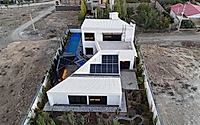
Outside, the landscape is tuned to air, shade and water. Shaded terraces, a pool, planted bands and a sunken courtyard are placed to keep breezes moving and temperatures moderated. The courtyard sits below grade and draws fresh southern air down into the lower floors, using a native olive tree as both shade and vertical marker. As wind slides across the pool and other water surfaces, passive cooling improves comfort without mechanical effort.
Native trees and plants extend the existing ecology rather than overwrite it. More than 300 planted trees continue local patterns of growth, softening edges where built form meets ground. Everyday routes pass close to planting, so interior life remains visually and climatically tied to seasonal change.
Carved Interiors And Reuse
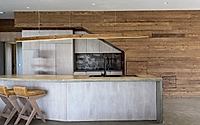
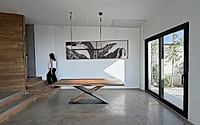
Inside, materials echo the idea of a carved mountain. Excavated stones return as walls, stairs, furniture and even lighting, their irregular surfaces catching daylight and artificial glow. Industrial remnants such as railway sleepers gain second lives as structure and fittings, reinforcing a sense that nothing leaves the site unnecessarily. Artworks are placed against these tactile backdrops, adding human scale rather than competing with the geology.
Rooms balance enclosure and openness in daily use. Residents move from deeper, protected lounges to brighter shared areas without losing orientation to the terrain. Light and air act as quiet guides, supported by the consistent presence of stone underfoot and on the walls.
Energy And Water In Balance
Energy use and resource cycles receive the same attention as form. Solar panels pair with energy recovery water heaters to trim operational demands over time. Greywater and rainwater recycling systems save more than 336 cubic meters of water per year, turning climate events into stored resources instead of runoff. Together with passive cooling strategies, these systems prevent over 53 tons of CO₂ emissions, lending quantitative weight to the project’s Vision Zero goal.
As day ends, shadows from tree canopies stretch across stone courtyards and low volumes. The house recedes into the hillside outline while interior rooms remain connected to night air and subtle sounds. Rock Villa closes each day by returning residents’ focus to mountain, breeze and the careful tuning that holds them together.
Photography courtesy of Raad Group
Visit Raad Group