The Catcher by TEAM_BLDG
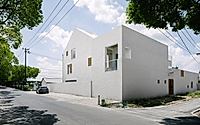
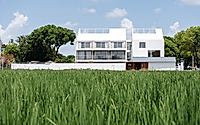
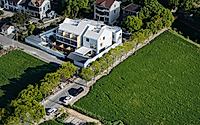
The Catcher stands on the outskirts of Shanghai, China, where rice fields press close to the walls of a once-ordinary rural compound. TEAM_BLDG transforms this house into the Chunli Guesthouse, turning two self-built homes into an 11-room retreat framed by courtyards, terraces, and sunken seating. Guests move between interior and landscape in measured steps, watching the fields slide past as the architecture folds around them.


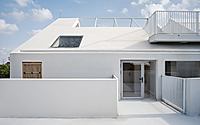
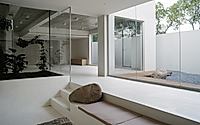
Low rural walls give way to a rectangle of courtyards and roofs, edged by the long horizon of rice fields. Light drops into sunken seating at the lobby, catching garden leaves and textured surfaces before it settles on the floor in loose patterns.
This house-turned-guesthouse, set near the ancient town of Xinchang in suburban Shanghai, carries the daily program of Chunli Guesthouse through a framework of old masonry and new connectors. TEAM_BLDG works with two existing self-built rural houses, adding three volumes at the site’s corners to create 11 rooms, public halls, and layered outdoor terraces. The throughline is adaptation under constraint: preserving what stands, inserting only what is needed, and using circulation to stitch guest rooms, courtyards, and fields into a single continuous experience.
Linking Houses And Fields
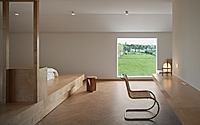
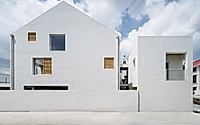
Rice fields sit just beyond the compound, their horizontal bands setting both the view and the project’s quiet tempo. A continuous perimeter wall gathers the two original houses, former courtyards, and new additions into one contained site, like a drawn frame around the broad landscape. Within that frame, openings and framed vistas direct the eye back to the fields, so guests never lose contact with the surrounding cultivation.
At the entrance, a gable-roofed wooden bungalow is kept in place, its form slightly at odds with the new volumes yet retained as a familiar rural marker. The roof changes for safety, now clad in aluminum-magnesium-manganese panels that handle weather and age, but the body of the house stays close to what local memory recognizes. Old and new sit in measured dialogue, each reinforcing the project’s bond to its setting.
Circulation As Core Framework
Movement through the compound becomes the main organizing tool, not a leftover diagram after rooms are placed. Three new architectural volumes slip into the rectangular site’s corners, housing the lobby, pavilion, and banquet hall while bridging between existing houses and open courts. These connectors pull public functions into clear positions and set up a legible rhythm between shared and private realms.
Guests cross from entrance to lobby, then drift along covered links and open terraces that alternate between enclosed rooms and semi-outdoor thresholds. Each turn adjusts the level of exposure to wind, light, and field views, so circulation doubles as a sequence of changing conditions. Pathways do more than lead; they structure everyday use, from banquet gatherings to quiet movement back to guest rooms at night.
Working With Terrain And Light
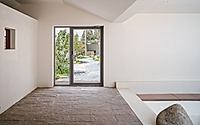
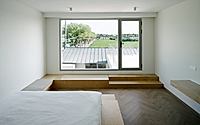
Inside the lobby, the ground drops into a sunken seating area that follows the existing terrain instead of leveling it away. This simple change sets up a subtle theater between interior and the small courtyard, allowing seated guests to look outward through a low, generous aperture. Sun and garden foliage slide across the recessed floor over the day, thickening the transition between inside and outside.
Semi-outdoor areas sit between enclosed rooms and the courtyards, layering thresholds rather than drawing a sharp line at the wall. These in-between zones pull in breezes and filtered daylight while connecting to rooftop terraces and outdoor rooms, making public life in the guesthouse feel continuous with the weather. Light, ground, and enclosure work together to give ordinary routines a measured pace.
Preservation, Intervention, And Cost
Renovation brings close contact with constraint: uneven existing structures, budget limits, and local approval processes all sit on the table from the start. TEAM_BLDG chooses to preserve as much of the original fabric as possible, adjusting only where safety, function, or clarity demand a change. Each intervention is justified, from the new roof cladding to the placement of corridors and terraces, so the composition grows directly from need.
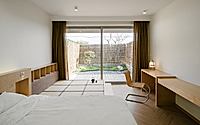
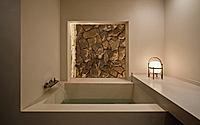
In guest rooms, a fixed furniture system condenses beds, storage, and other functions into integrated elements that control cost and construction complexity. Landscaped views outside soaking areas are shaped not just for visual pleasure but to conceal exposed pipes and rough services along the walls, turning practical concealment into composed scenery. Local construction techniques guide details, with simplified junctions and durable materials that contractors can execute cleanly and maintain over time.
Guesthouse As Mediator
Beyond its program, the guesthouse acts as a mediator between everyday rural life and visiting guests. Old walls, new corner volumes, and gently arranged gardens hold traces of local memory while absorbing contemporary routines like banquets, mahjong games, and quiet retreats. The compound stands still; people and seasons turn through it.
By dusk, courtyards catch the last light glancing across the rice fields before it falls onto the perimeter wall. Guests return along familiar paths, reading doors, thresholds, and soft exterior glow as wayfinding rather than signage. In that daily loop, The Catcher keeps its watch over land, work, and passing time without raising its voice.
Photography by Hu Siyuan
Visit TEAM_BLDG