Oval House by Jorgelina Tortorici & Asociados
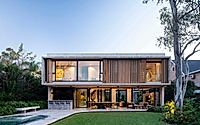
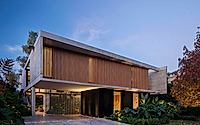
Oval House anchors a gated neighborhood in Buenos Aires, Argentina with a quiet yet assertive concrete presence by Jorgelina Tortorici & Asociados. The house wraps an internal oval courtyard, turning what could be a suburban perimeter into an inward-looking sequence of rooms and voids that balance openness, privacy, and controlled light. Everyday life gathers around this carved interior world, where marble, oak, and glass temper the rigor of the concrete shell.


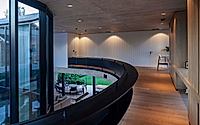
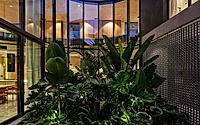
A rigid concrete box meets a soft oval void. Daylight slips between gallery and courtyard, tracing curves in marble underfoot and catching on the fine edges of aluminum louvers.
Within this framed contrast, Oval House in Buenos Aires, Argentina, by Jorgelina Tortorici & Asociados arranges a family house around an internal patio rather than the street. The U-shaped plan hugs the central courtyard, turning the open sky into the primary room and using concrete, glass, and sunshades to tune light, privacy, and climate. Everyday routines orbit that void, reading the house as a thick perimeter that reveals a far more fluid interior world.
Carving The Oval Heart
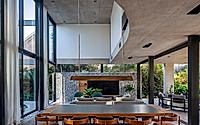
The project begins with a single gesture: an oval patio cut from a solid mass. That void generates the U-shaped arrangement that folds around it, so the courtyard becomes both interior garden and organizing hall. From the semi-covered entrance, a gate masks this inner room, extending the reveal and heightening the shift from wooded neighborhood to enclosed court. Once inside, the patio connects directly to a double-height volume for public use, where living, dining, and kitchen hold visual contact with the open sky.
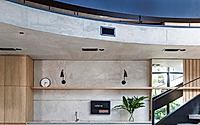
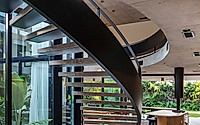
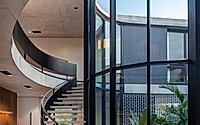
The oval geometry softens the strong Cartesian shell. Concrete and glass boundaries curve and taper, producing plastic, almost liquid edges that stand against the box-like exterior. Each turn of the plan frames the courtyard from a new angle, so circulation reads less like corridor and more like a sequence of small episodes tied back to the same central void.
Structuring Daily Life
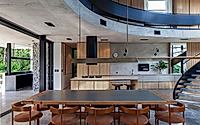
Program settles into clear bands around this interior garden. A southern block resolves service functions, freeing the main double-height room to work as a generous shared volume where family and guests gather. The kitchen sits at the heart of that room, fully integrated with dining and oriented to oversee activity in every direction while appliances disappear into cabinetry to keep the volume visually calm.
The living area hovers between two exteriors, the gallery on one side and the oval patio on the other, so the room reads as a bridge suspended between landscapes. Above, a U-shaped slab traces the courtyard edge and holds bedrooms that all look into the central void, with one wing for children and another for the master suite. Instead of conventional hallways, the route becomes a continuous passage of moments, where each landing and threshold doubles as a place to pause.
Concrete, Marble, And Oak
Concrete carries both structure and character, giving the house its clear weight and enabling broad spans around the courtyard. That material is pushed toward a more plastic expression, with curves guiding how slabs meet walls and how openings taper, turning the structural frame into a set of sculpted surfaces. On the ground floor, Tundra Grey marble runs in a continuous field from entrance to the underwater pool, its texture and tone tying interior, terrace, and water into a single horizontal plane.
Above, oak flooring replaces stone, bringing a warmer, softer feel to the private rooms and encouraging barefoot movement in the upper ring. The basement, conceived as a free-use area, still holds a connection to outside conditions thanks to custom skylights that pull daylight and air down through the concrete thickness. Throughout, joints and intersections express the curve as a recurring theme, from large-scale patio edges down to points where materials meet.
Light, Shade, And Air
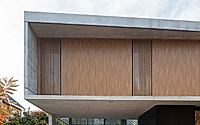
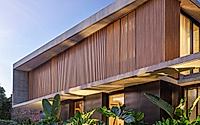
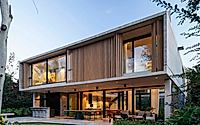
Careful study of solar orientation underpins the envelope. Aluminum sunshades wrap facades according to exposure, folding or sliding to protect glass from direct sun and tune interior brightness. At the front, a continuous aluminum surface with a wood-like finish grants privacy and a controlled relationship to the street, with a mix of fixed, sliding, and folding panels.
Toward the rear, the house opens, adopting a more transparent character where sunshades adjust depth of shade for each room. Cross ventilation and natural light shape every interior, working with the courtyard void to move air diagonally through the plan. By day, these devices modulate glare; at night, they act as a thin, patterned layer between lit rooms and the quiet neighborhood.
As the route returns to the entrance, the experience contracts back to the heavy outer volume. The oval patio remains visible from multiple points, holding the memory of curves and light against the concrete shell. In that tension between rigid box and soft void, Oval House finds an enduring balance of mass, material, and daily ritual.
Photography courtesy of Jorgelina Tortorici & Asociados
Visit Jorgelina Tortorici & Asociados