Timbertop House by Akb Architects
Timbertop House is a house in Canada by Akb Architects, conceived as a contemporary weekend retreat for an active family of five. Designed in 2024, the project draws on the language of local farm buildings while adjusting its gabled form to the site’s uneven terrain and long views across the Niagara Escarpment. Inside, a single-story plan and durable materials support daily use in every season.


About Timbertop House
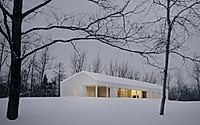
Rooted in the language of traditional farm architecture, Timbertop House is a contemporary retreat conceived as a weekend home for an active family of five. Set on a hilltop clearing, the residence looks across southwestern Ontario’s Niagara Escarpment, with views over undulating farmland and forested ridges. The 200-acre property is almost entirely woodland, home to deer, porcupines, and wild turkeys. Privately owned and carefully managed, the land is crossed only by footpaths and UTV trails that wind through dense pines and mature maple groves.
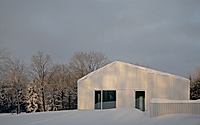
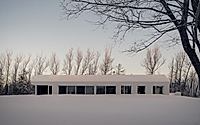
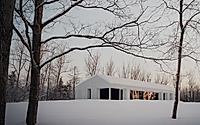
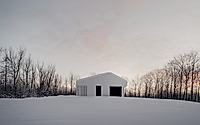
The home’s gabled form draws on regional agrarian types, including single-story barns and modest farmhouses, then reworks them through a modern lens. Its roofline skews slightly off axis, a subtle move that refreshes the familiar pitched silhouette and helps the building settle into the site’s uneven terrain. That shift also opens the house to its strongest view, toward the forest descending along a nearby slope. Along the southern edge, glass walls open onto a deck without railings, establishing a direct relationship between the interior and the landscape. The deck wraps around to hold a cedar-clad hot tub on a raised platform.
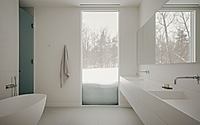
Rather than relying on a cantilever, the house maintains a continuous roofline, with voids carved beneath it to form a sheltered entry and a screened dining and lounge room beside the kitchen. Elsewhere, full-height windows sit deep within 26-inch architectural frames, providing passive shading and privacy without cutting off daylight.
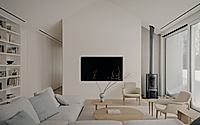
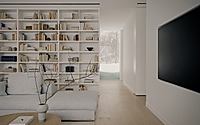
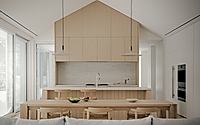
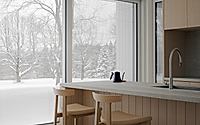
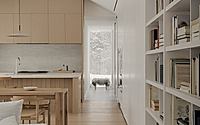
Designed for active use in every season, the interior places function and ease at the forefront. Its single-story layout supports the daily rhythms of a busy family while also accommodating a quieter pace of life. A large mudroom with laundry sits directly off the main entry, giving sports gear and wet boots a practical place to land. From there, circulation moves into the communal core, where a vaulted ceiling spans an open kitchen and harvest table at one end and a generous living area with a built-in wall library at the other.
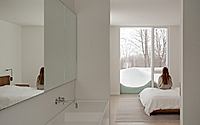
Private rooms are arranged along a wide corridor. Three children’s bedrooms share a central bathroom, while the primary suite and ensuite sit at the end of the hall. For extra privacy, a handle-free pivot door that reaches the ceiling can close off the main bedroom completely from the rest of the house.
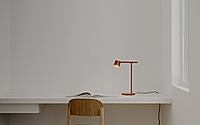
Throughout, modern interventions bring new life to traditional references. White board-and-batten cladding and white oak floor planks recall rural vernacular building, interpreted with a pared-back sensibility. Beneath the floors, high-efficiency radiant heating adds technical performance to tactile warmth. The woodburning stove is intentionally understated, set into a corner in the spirit of the utilitarian hearths found in older farmhouses. A television screen, essential for a young family, is recessed into the wall so it reads as a quieter geometric element within the pale interior palette.
Subtle detailing gives the house much of its sensory depth. The kitchen table extends the architecture into furniture, drawing on a barn-like sense of weight and permanence. Its solid wood top is made from uninterrupted planks that emphasize grain and texture, while its heavy legs echo the massing of the kitchen island and the structural clarity of the house itself. The table’s natural tone aligns with the floors and custom cabinetry, creating continuity across the interior. Interest comes less from contrast than from orientation: vertical and horizontal grain patterns quietly animate adjacent surfaces. The same logic continues in the bedroom corridor, where the floorboards shift direction to run east-west, guiding movement and marking the transition from the open communal core to the private rooms.
Together, these decisions produce a home that feels grounded in local building traditions and closely tuned to daily life. Past and present meet here with restraint, allowing the routines of family life, the changing seasons, and the surrounding landscape to stay in clear view.
Photography by Félix Michaud
Visit Akb Architects