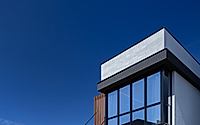
House Light by Leonardo Tulli
House Light is a 2025 house in Curitiba, Brazil, by Leonardo Tulli. Designed for an urban lot with tight side boundaries, it turns the home inward and pulls daylight from above. A retractable roof, central void, and carefully placed stair keep the interior bright while preserving privacy from the street.


About House Light
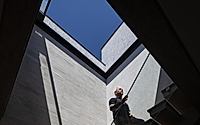
House Light is designed to answer a familiar challenge on dense urban lots: the lack of side and rear windows caused by neighboring buildings set close to the property line. Rather than rely on openings along the edges, the house reverses the usual perspective and brings light and ventilation from top to bottom.
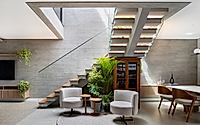
The result is a home organized around a bright central void. In Curitiba, Brazil, Leonardo Tulli shapes the interior as a sequence of rooms connected by light, with privacy maintained at the perimeter and daylight drawing the plan inward.
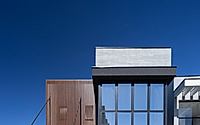
The façade is composed of robust volumes. Exposed concrete and vertical wooden brise-soleils give the front elevation a restrained presence on the street while also filtering direct sun and protecting the family’s privacy.
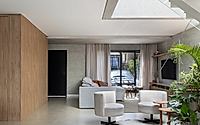
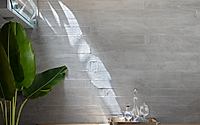
A retractable roof sits above the central opening and works as the house’s main source of natural light. That motorized panel compensates for the absence of windows on the sides of the lot, sending light deep into the core of the home throughout the day.
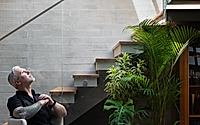
Directly below, the staircase becomes a transparent vertical axis. Wooden treads and a glass railing allow daylight from above to pass through, so the ground floor stays luminous even as the stair links the levels.
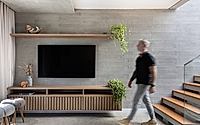
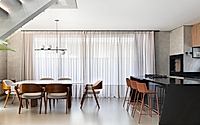
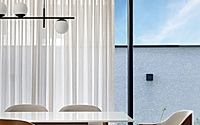
On the ground floor, the living room, dining area, and kitchen are fully integrated. The open arrangement supports daily movement and keeps sightlines clear, while also letting daylight travel across the main communal rooms without interruption.
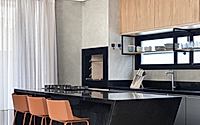
In the kitchen, a black brushed granite island introduces a dense, dark counterpoint to the lighter surfaces around it. Its diagonal cut gives the island a sharper profile, and the cooktop placement lets the resident face the living areas while cooking, keeping conversation easy across the room.
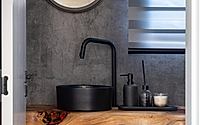
The powder room uses a different kind of continuity. A wall covering already owned by the homeowner and saved from a previous project is reused here, paired with a solid wood vanity cut from a natural tree trunk. Black fixtures and a matte vessel sink complete a room that feels direct, tactile, and carefully considered.
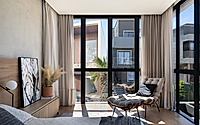
Upstairs, the private rooms keep a visual connection to the central void. The master suite is arranged to make the most of sunlight, with a large glass opening and a reading chair placed where the sun enters most strongly.
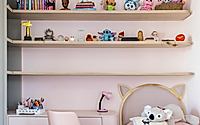
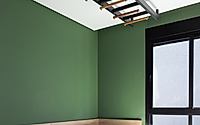
The children’s bedrooms reflect different needs within the same family home. One uses a green palette and a metal climbing structure fixed to the ceiling for active play, while the other relies on linear niches and custom millwork that can adapt as the child grows.
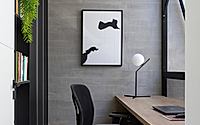
The office is set on the mezzanine facing the void, where it feels almost like a balcony under cover. Across the house, glass, exposed concrete, and wood establish a steady material rhythm that supports light, structure, and everyday use.
Photography courtesy of Leonardo Tulli
Visit Leonardo Tulli