Yield House by Splyce Design
Yield House rises above Vancouver, Canada, as a house conceived for extended family gatherings by Splyce Design. Set on an east–west lot in the city’s westside, the project balances privacy from the sidewalk with long views to mountains, ocean and skyline. Guests move through a measured sequence of walls, stairs and framed outlooks, arriving in a calm interior where social rooms, tucked service zones and quiet retreats stay connected yet distinct.


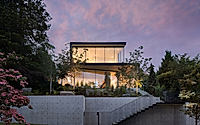
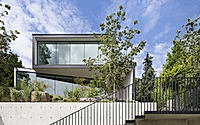
A tall concrete wall catches the first light along the sidewalk while the house holds back, elevated above street level. Between the two, a path climbs through planted terraces and shadowed steps before arriving at a calm front entry that already feels removed from passing traffic.
This is a house in Vancouver’s westside designed by Splyce Design for a family that hosts guests year-round. The brief leads to a clear focus on movement, from street to door and from shared rooms to quieter corners out of the way. Each level answers a different part of daily life, yet recurring materials and alignments keep the experience legible.
Layered Street Approach
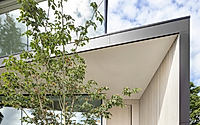
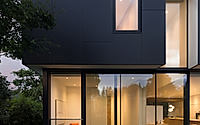
The pedestrian route begins at that concrete wall with its cantilevered stair, the first built layer that screens the sidewalk and sets the tone. As visitors climb, more low walls and changes in level register as a gentle sequence, placing the main volume about 17 feet above the public realm and protecting interior rooms from direct street views. A continuous dark band of cementitious panel trims the elevation, so the upper level reads as a distinct silhouette against the sky. Large glass panes sit flush within this band, their concealed frames giving the entry side a light, almost hovering quality.
Axis Through Daily Life
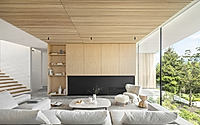
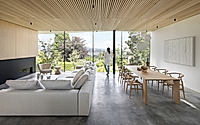
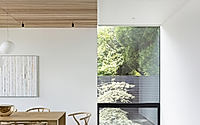
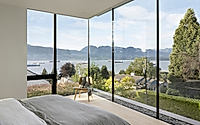
Inside, a north–south axis organizes the main floor and keeps circulation straightforward. Windows at both ends anchor this line and mark a subtle rotation in the plan toward panoramic views of city, mountains and ocean beyond. The main rooms cluster along this path, so walking through the level means tracking changing light and outlooks rather than threading separate corridors. A timber ceiling reinforces the line overhead, visually separating adjacent zones while adding warmth to the predominantly white interior.
Quiet Social Core
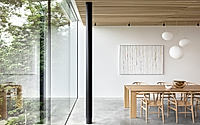
The primary social areas read as one open volume: kitchen, dining and living arranged without hard breaks, ready for family gatherings that expand and contract. Material restraint keeps the atmosphere calm, letting the plan do much of the work in shaping how people move and pause. Large sliding glass doors pull the rear deck into this core, extending the room onto grade and allowing movement to spill easily outside in good weather. At the same time, support zones sit just out of direct sight so daily routines stay close but not on display.
Hidden And Connected Rooms
Behind the main kitchen, a prep kitchen hides behind millwork, reached through a door that reads as another cabinet panel. The mudroom tucks behind the kitchen as well, accessible yet screened from the central rooms where guests gather. A home office slips behind the living room wall, giving a place to focus while staying adjacent to family activity and shared light. On the upper floor, the stair landing turns into a small library with a seating nook, turning circulation into a place to linger.
Light Along The Stair
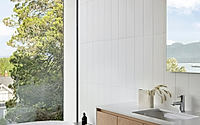
The main stair threads these levels together, washed in shifting daylight from a skylight and roof deck access above. A tall west-facing window brings in afternoon light and long views toward cedar and fir trees in the distance. Movement up and down becomes a recurring ritual, as changing weather and time of day register along the concrete, timber and white surfaces. That vertical journey quietly ties the elevated entry, shared rooms and tucked retreats into one clear sequence.
In the end, the house stands apart from the street yet stays strongly engaged with its surroundings through framed city and landscape views. Everyday paths for residents and guests pass through measured layers, from public sidewalk to upper landings, always with another outlook waiting around the turn. The result is a composed route through light and level changes that holds family life and visiting relatives in a single, readable whole.
Photography courtesy of Splyce Design
Visit Splyce Design