House GM by Didonè Comacchio Architects
House GM stands on the edge of Rosà, Italy as a composed concrete house by Didonè Comacchio Architects. The project arranges living and sleeping rooms around green patios, using solid and permeable surfaces to manage views, light, and privacy. Concrete, brick, and walnut set a restrained palette that lets the quiet shifts of daylight and courtyard greenery define the mood through the day.


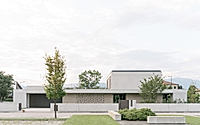
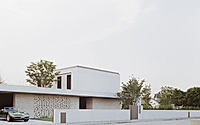
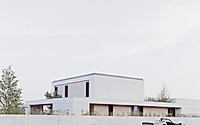
Concrete planes catch the light and throw thin shadows across the patios. From the street, a broad horizontal slab reads as a quiet threshold, with planted courts and brick layers shielding the life within.
This house in Rosà, Italy is a single-family residence conceived by Didonè Comacchio Architects around a few deliberate materials and a careful balance of exposure and retreat. The project relies on smooth gray concrete, light-toned brick, and warm walnut to build depth, texture, and privacy. Material choices drive the experience: structure doubles as enclosure, and every wall, membrane, and patio works as part of an atmospheric filter.
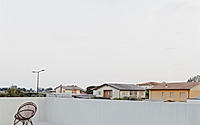
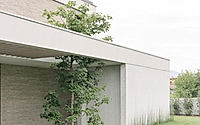
The large concrete slab shapes the primary silhouette and gathers the interior rooms beneath its protective reach. Two more volumes rest on this base, one holding the bedrooms and the other wrapping a sun terrace that opens directly from the sleeping level. This stacked composition keeps daily activity low and sheltered while lifting more private routines above, where light and air feel more direct. Under the slab, patios and permeable brick runs soften the boundary and make the mass read as layered rather than heavy.
Layered Concrete Form
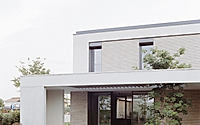
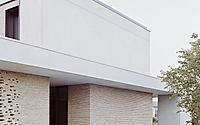
The main bodies of the house are cast in smooth gray concrete, their weighty surfaces setting a calm, almost infrastructural base for domestic life. On the ground floor, slender supports hold the slab so that walls slip between them in large-format light-colored bricks, set almost dry so each unit reads distinctly. Holes puncture these brick runs and are framed by brown metal fillings that sharpen the edges and tune daylight entering the interior. The interplay between concrete mass, porous brick, and metal-lined openings produces a clear rhythm as one walks around the perimeter.
Brick Membranes And Glazing
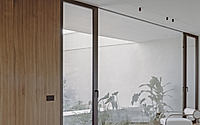
Between the supports, brick membranes serve as both enclosure and screen, modulating how much of the outside world filters inward. Windows and doors are detailed so that fixed panes present only glass, with framing pulled back, while operable portions remain legible as precise cuts in the surfaces. On the first floor, east and west elevations repeat this material cadence between bedroom windows, alternating glass and brick to calibrate light and privacy. The result is a building that feels closed when viewed obliquely yet opens generous views when approached from within the rooms.
Interior Warmth And Contrast
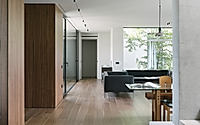
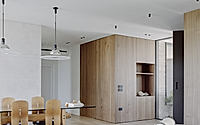
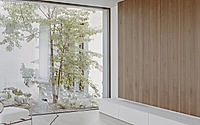
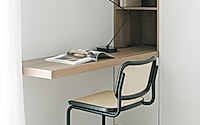
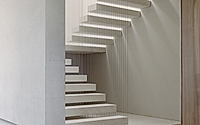
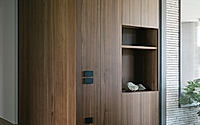
Inside, concrete returns in a suspended stair wall where a smooth finish reveals aggregates in a subtle, almost mineral pattern. Against this cool gray, walnut flooring brings warmth underfoot, while large boiserie panels and sliding doors in the same timber introduce a continuous, tactile band. Light gray wall surfaces sit between these materials, keeping the background quiet and letting the contrast between concrete and wood define each room. Sliding elements in walnut also sharpen transitions, opening or closing views and adding a sense of movement to otherwise stable construction.
Patios As Light Filters
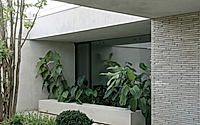
Two green patios cut into the mass and work as calibrated light wells for the house. Planting and walls around them manage glare and bring calm, controlled light into adjacent rooms while maintaining a sense of protection from outside views. Walking from kitchen to living room, or from porch past the kitchen, long sightlines catch glimpses of these planted courts and pull the eye through multiple layers. The patios consolidate the bond between daily routines and greenery, even as large windows remain present and generous.
In the end, mass, membrane, and garden act in concert under the broad concrete slab. Concrete and brick handle the work of structure and enclosure, while walnut and planting soften the experience from within. As the day shifts, light passes through brick holes, glass panes, and leafy patios, constantly rewriting how the house feels without altering its clear, grounded form.
Photography by Simone Bossi
Visit Didonè Comacchio Architects