The Avber House by OFIS Arhitekti
The Avber House sits on a hilltop in Avber, Slovenia, where OFIS Arhitekti reworks a clustered stone homestead into a contemporary house rooted in ancestral memory. The project gathers dwelling, former stable, and outbuilding around a sheltered courtyard, translating vernacular Karst elements into a renewed everyday setting for an Australian client returning to his family village. Historic structures stay present, while their roles shift toward present-day comfort and restrained sustainability.


Wind presses along the Karst plateau while stone walls hold firm and quiet. Inside the enclosure, the courtyard draws in softer air and filtered village sounds.
Within this cluster of buildings, life threads between rough stone, timber shutters, and the weighty roof tiles overhead, tying present routines to an older rural order.
The Avber House is a house in Avber, Slovenia, where OFIS Arhitekti reworks a traditional Karst homestead for a client returning from Australia. The project focuses on reuse and restraint, keeping the existing courtyard compound intact while adapting former agricultural structures for contemporary living. Heritage elements stay legible, yet their functions adjust to current expectations of comfort, efficiency, and daily rhythm.
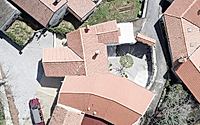
A central borjač anchors the ensemble, once a defensive and practical heart that sheltered people, animals, and harvest from harsh burja winds. Around it stand the two-storey dwelling, a stable, and an outbuilding, restored as a close-knit group that maintains the village’s dense grain. Architectural work concentrates on preserving this protective order while testing how much can be transformed without breaking the memory woven into stone, timber, and tile.
Reworking The Borjač
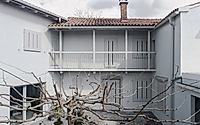
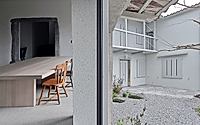
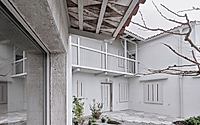
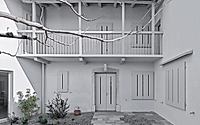
The enclosed courtyard now acts as an outdoor living room, where wind protection and exposure to village life meet in one measured volume. Walls that once corralled livestock now frame places to sit, gather, and move between interior rooms, turning former thresholds into an everyday route. The microclimate created by these stone edges still moderates burja gusts, but now it also extends the seasons of use. Light crosses the paving and climbs the façades, making the courtyard a steady middle ground between house and settlement.
Stone Walls, New Roles
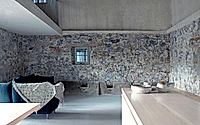
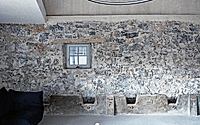
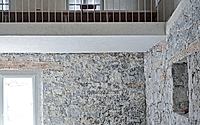
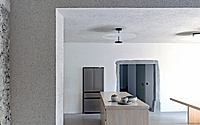
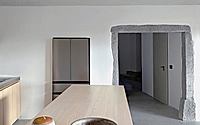
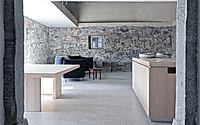
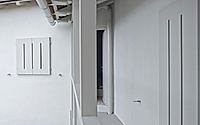
Across the estate, exposed stonewalls stay visible, their rough texture carrying signs of long agricultural work. Former farm elements are reassigned with care: a cow’s feed trough becomes shelving, and small niches once used for tools turn into storage for contemporary life. This reuse holds onto proportion and material memory while trimming away excess intervention. Rooms read as lean and purposeful, framed by structure rather than new ornament.
Vernacular Elements Recast
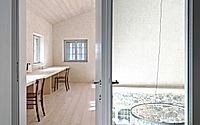
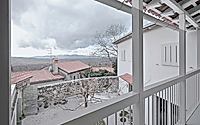
Traditional Karst motifs remain present, but their roles adjust to new patterns of occupation. The upper-level gank, or balcony, offers circulation and outlook, carrying people along the façade above the courtyard. Wooden škure on the windows regulate light and privacy while staying true to familiar forms. Heavy korci roof tiles keep their characteristic layered surface, now sitting over an upgraded interior that targets comfort and energy efficiency without visual excess.
Restraint And Continuity
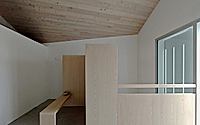
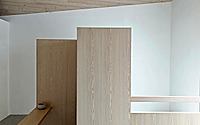
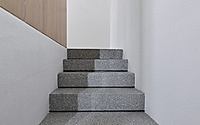
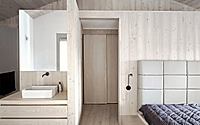
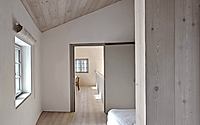
Interventions follow a principle of doing only what is necessary, preserving existing material wherever possible. Roof structures are repaired rather than replaced, stone repaired and left bare, timber shutters revived for another generation of use. Interiors gain clarity and daylight through reorganization rather than wholesale demolition, reinforcing the original clustered layout. The house becomes both a private dwelling and a legible demonstration of how rural heritage can keep evolving while staying anchored in its own building logic.
As the wind rises across the plateau, the compound closes ranks, just as it did for earlier families. Inside the courtyard, the house gathers light, stored stories, and updated routines. The project points toward a future where Karst homesteads continue as working homes, their reuse grounded in existing walls and the enduring pattern of courtyard, dwelling, and outbuildings.
Photography by J. Martinic
Visit OFIS Arhitekti