Shell: Brick House as Quiet Urban Refuge
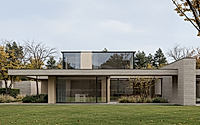
Shell is a courtyard house in Kyiv, Ukraine, conceived by Bezmirno as a quiet brick refuge on the edge of the city. Behind its monolithic shell, the home turns inward toward a planted patio, where light, texture, and family life concentrate around a single protected void. The project balances robust exterior architecture with a warm, flowing interior sequence tuned to daily rituals.


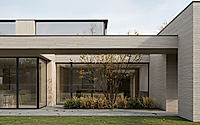
Long-format brick catches low light along the street, its rough surface registering each change in weather and shadow. Past the reserved facade, the house opens toward an inner court where a single tree steadies the composition and draws the eye through the depth of the plan.
This is a house in Kyiv for a family, shaped as a compact patio residence rather than a suburban pavilion, and it is designed by Bezmirno as an introverted urban refuge. The real drama lies not in the exterior profile but in the way movement, views, and levels orbit the protected courtyard. Daily life unspools along a clear sequence: from shielded perimeter to open core, from communal ground floor to a quiet upper world of rest.
At the heart of the concept sits what the team calls “transparent privacy,” a paradox that guides every layout decision. Rooms remain visually porous toward the patio yet remain closed to the street, so the family can live with broad glass surfaces without exposing themselves to the city. Circulation avoids dead corridors; paths become occasions for framed views, changing light, and a steady dialogue between brick, wood, and garden.
Courtyard As Interior Room
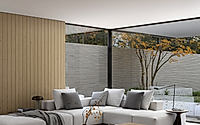
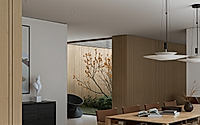
The central patio reads less like an exterior gap and more like an open-air room around which everything else revolves. Large sliding glass surfaces pull the courtyard deep into the interior, so living, dining, and circulation align with the tree as a constant focal point. Nature becomes part of the daily route, not an afterthought at the edge of the plot. Privacy stays intact because every broad view turns inward, toward planted ground and sky.
Day Zone In One Sweep
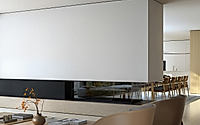
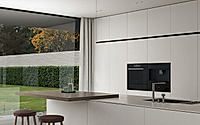
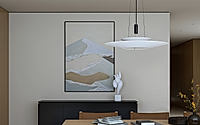
On the ground floor, the day zone runs as one continuous volume, joining kitchen, dining, and living room without full-height partitions. Zoning relies on the placement of furniture groups, ceiling height shifts, and light rather than heavy construction. A family can move from preparing meals to lingering at the table to resting in the lounge without crossing thresholds or closing doors. The result is open, but the patio keeps the scene contained and calm.
Gallery As Transit
Where many houses hide circulation, here the corridor becomes a gallery. A generous window opposite the stair transforms what could be a narrow passage into a light-filled promenade along the garden. Movement up and down the stair is paired with long views, turning a practical route into a daily moment of pause. Transit is no longer leftover area; it works as a lived-in part of the home’s core itinerary.
Quiet Upper Realm
The entire second floor forms a self-contained private level for the owners. A master bedroom receives soft, filtered light rather than harsh direct glare, underscoring its retreat-like character. Nearby, a bathroom set against a panoramic window opens directly to the forest view while still protected from outside sightlines. Rest, care, and solitude take place above the social ground floor, with the stair acting as the hinge between communal life and withdrawal.
Materials Guiding Movement
Material choices reinforce the way the house is walked and used. Long-format brick continues from facade to selected interior surfaces, carrying the sense of mass and rhythm right into the main rooms. Natural wood cladding and furniture add warmth along routes between zones, so every handrail, door touchpoint, or bench edge feels tangible and grounded. Large-format glass surfaces sit between brick and wood, thinning boundaries to the patio and drawing people toward the central tree.
As the day passes, light tracks across brick joints, timber grain, and the leaves of the courtyard tree, marking time within the plan. The house remains outwardly reserved, but inside, paths, rooms, and landings keep connecting back to that quiet green center. In the end, Shell reads as a protective loop around a modest garden, tuned to keep the city at bay while holding family life in close, calm proximity.
Photography courtesy of Bezmirno
Visit Bezmirno