Casa Tupin Frames Courtyard Living Amid Brasília’s Native Landscape
Casa Tupin sits within a gated community on Brasília’s Park Way, where BLOCO Arquitetos shapes a concrete house around a calm interior court. The single-family residence leans on exposed structure, suspended slabs, and native cerrado vegetation to link its social rooms and private wings while holding onto the loose character of the surrounding landscape. Inside and out, the composition keeps the house airy, open, and tuned to the Brazilian plateau light.


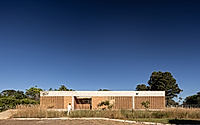
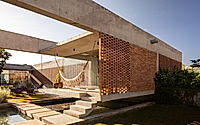
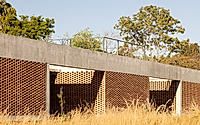
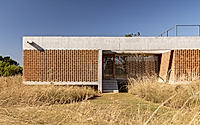
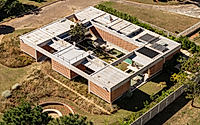
Low concrete planes cast measured shadows across native cerrado ground as Casa Tupin lifts gently above the soil. Under the elevated slabs, light threads between pillars and vegetation, drawing the eye toward a central court.
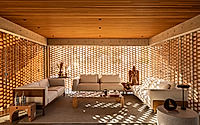
This house in Brasília’s Setor de Mansões Park Way is a single-family residence by BLOCO Arquitetos that concentrates daily life around an open courtyard. The project relies on structure, rather than ornament, to connect interior rooms with the garden and to choreograph movement between social and private areas. Structural choices set the tone: exposed concrete, twelve primary pillars, and post-tensioned beams work together to span distance, manage the terrain, and pull the outdoors deep into the plan.
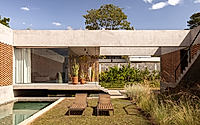
Set within a gated community about 20 km from Brasília’s Plano Piloto, the plot holds generous proportions and native cerrado vegetation. The architects keep this context legible by lifting portions of the floor slabs above the land, allowing the landscape to continue underneath and keeping a visual field of plants and soil uninterrupted. Domestic routines gather around a central courtyard that doubles as backyard and leisure hub, tying together pool, barbecue, and living rooms in a single continuous sequence. Everyday circulation always returns to this void, so family and guests pass through air, shade, and greenery between more enclosed rooms.
Structuring The Courtyard
The residence organizes itself around the courtyard, which anchors both social and private wings. On one side sit living and dining rooms oriented toward the pool and barbecue terrace, while on the other side, bedrooms gain quiet views and direct access back to the same open core. This configuration creates a clear route for movement without long corridors, so people drift between lounging, cooking, and resting with constant outdoor contact. The court reads as a shared heart, held by concrete edges yet open to sky and breeze.
Elevated Slabs And Terrain
Sections of the floor slabs are conceived as semi-suspended planes that respond to subtle level changes in the site. Rather than cutting or filling extensively, the architects let concrete hover lightly above the existing contours, signalling each shift in elevation with a crisp structural line. This strategy keeps the ground accessible for small animals to pass beneath and allows native vegetation to remain in place. It also reinforces a sense of visual continuity, since the eye can read the underside of the house and the terrain together as one layered field.
Twelve Pillars And Long Spans
The main structure rests on only twelve primary pillars, supplemented by perimeter post-tensioned beams and internal suspension elements. With so few supports touching the ground, large cantilevers extend over outdoor areas and create wide social rooms free from intrusive columns. This configuration widens views and simplifies interior layouts, while reducing the amount of concrete in direct contact with the soil. Less contact helps thermal performance, since fewer elements conduct ground heat into living areas during hot periods.
Concrete As Continuous Skin
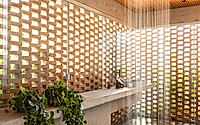
Exposed concrete runs from structure to leisure areas without cladding, giving the house a single clear material presence. Pool edges, barbecue stalls, and structural beams share the same finish, so joints between function and form remain legible rather than concealed. This material continuity underlines the direct relationship between engineering and daily use; the same elements that hold the roof also frame social life around the courtyard. Under changing light, subtle variations in the concrete surface register time, weather, and use.
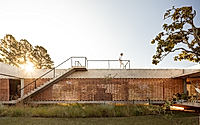
As day moves across the plateau, the elevated slabs cast shifting bands of shade over the central court and the vegetation below. Children, guests, and wildlife navigate the same layered ground plane, passing between concrete, soil, and water in one loose circuit. Casa Tupin stands as a precise structural object in the cerrado, yet its raised planes and open court keep the house engaged with breeze, light, and the living ground beneath.
Photography courtesy of BLOCO Arquitetos
Visit BLOCO Arquitetos