Casa Dos Sobreiros II: Light-Filled Living in Coastal Portugal
Casa dos Sobreiros II sits in Póvoa de Varzim, Portugal, as a rigorously ordered house by Urbanpolis that orients daily life around light and sequence. The home uses two primary axes, a courtyard heart, and a south-facing garden edge to choreograph how family, guests, and views move through the rooms. Continuous white surfaces and precise volumes underline a calm, contemporary character rooted in clarity rather than excess.


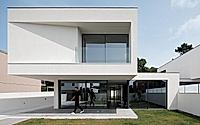
Late light brushes the south garden as the upper volume casts a long shadow across the terrace. Through the glazed ground floor, the central patio reads as a calm, bright void that pulls the eye inward before releasing it back out to the lawn.
This is a house organized by movement and framed by light rather than by isolated rooms. Casa dos Sobreiros II, a single-family house in Póvoa de Varzim by Urbanpolis, sets up two strong axes that guide circulation and define how social and private life intersect. The transversal route through the patio and the longitudinal gallery along the garden work together as a clear armature, turning everyday routines into a measured sequence instead of a loose drift.
Arriving Through The Side
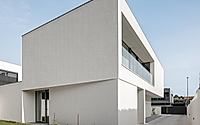
Approach begins at the flank, not the front. The entrance sits on the side elevation, so the path in becomes a gradual reading of the volumes rather than an immediate reveal. As visitors walk along the carved recess that shelters the door, the overlapping forms of the house unfold step by step, holding back direct views into the social rooms and reinforcing privacy for those already inside. This angled arrival lays the groundwork for the internal sequence, where circulation is always slightly offset from the most open areas.
Crossing The Central Patio
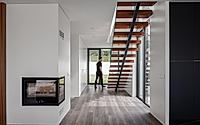
Inside, the transversal axis takes over. The entrance hall aligns with a central patio that pulls daylight into the middle of the plan and anchors circulation around a quiet outdoor void. Moving along this route, residents pass between solids and transparencies, with the patio acting as both pause and pivot point for the ground floor. Light from above washes walls and floor, transforming what could be a simple corridor into a lived-in gallery that links everyday activities.
Living With The Garden
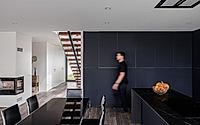
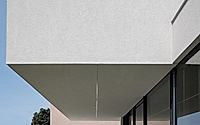
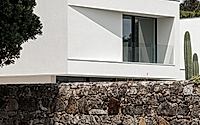
The social rooms on the ground level stretch toward the southern garden. Large glazed openings slide or stack along this edge, so the living room and kitchen read as one continuous zone with the exterior. When the upper volume projects outward, it creates covered terraces that extend daily life outside while giving shade and thermal comfort during hotter hours. Family routines move easily between cooking, dining, and sitting under the cantilever, where the garden becomes a direct extension of interior life.
Climbing To The Private Level
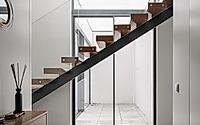
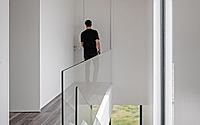
A vertical opening links the two floors, drawing light down into the stair and broadening the perception of height. At the top, a longitudinal gallery runs parallel to the garden, connecting bedrooms while keeping the route legible and calm. Each room pulls back into its own recess or opens to a balcony, so residents gain privacy without losing the generous daylight that defines the house. Along this axis, the slight inclination of the suite wall adds a quiet tension—catching sun differently through the day and giving the facade a subtle sense of motion.
Volumes, Light And Restraint
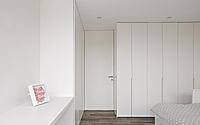
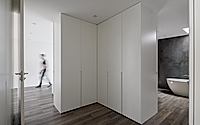
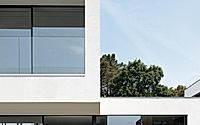
Around the house, each elevation responds to orientation and use. The south face leans into its role as garden edge, with the long cantilever expressing the social rooms below and shading the outdoor living areas. In contrast, the north facade presents as an almost solid plane, punctured only where the entrance needs to announce itself and where interior brightness can mark the threshold. Inside, continuous white surfaces, minimal-frame glazing and uniform flooring keep attention on proportion, light, and the measured play between void and mass at every turn.
By night, discreet lighting traces the main volumes as if outlining a carefully cut model. The house reads as one composed object, yet daily life still moves along the same clear routes set by patio, stair, and garden. In that balance between ordered circulation and quietly changing light, Casa dos Sobreiros II holds a steady rhythm for living that feels both precise and relaxed.
Photography by Ivo Tavares
Visit Urbanpolis