Ca na Baldu i en Diego — Quiet Minimalism Above Tibidabo Hill
Ca na Baldu i en Diego reimagines a single-family house at the foot of Tibidabo in Barcelona, Spain, with studio Atzur guiding the transformation. The project turns a once-fragmented dwelling into a calm, light-steeped home, using reworked volumes and clearer circulation to bring air, views, and family life into easy conversation. Rooms now read as generous, adaptable scenes rather than isolated compartments.


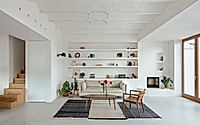
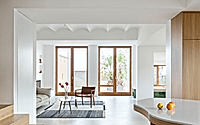
Late afternoon light slides in through tall timber-framed openings and lands on pale floors, catching the edges of built-in shelves and the outline of a simple stair. A once-broken sequence of rooms now reads as a single, calm living level where cooking, lounging, and play sit within sight of one another but keep their own rhythm.
This project is the refurbishment of a single-family house in the Sarrià–Sant Gervasi district, where additions over time left an irregular set of volumes and awkward interior proportions. Atzur works with that complexity instead of erasing it, using structure and circulation to stitch the house into a clear, continuous plan. The guiding ambition is straightforward: improve natural light and ventilation while allowing for flexible everyday use and preserving traces of earlier construction.
Opening Up Volumes
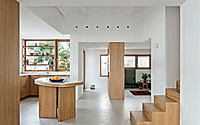
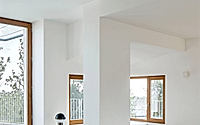
Walls that once chopped the ground floor into small rooms give way to broad alignments, so sightlines now run from the kitchen to the living area and out toward the garden. Structural elements stay legible as beams, piers, and lowered soffits, setting gentle thresholds rather than hard separations. White surfaces bounce daylight deep into the interior, while the exposed ceiling pattern records the house’s layered past in quiet relief.
Living Level As Heart
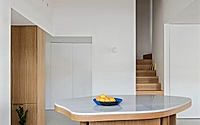
At the center, an open living room arranges everyday life along one long façade, anchored by a run of shelving, a fireplace, and low furniture. Rugs draw islands of use across the continuous pale floor, marking out a sitting area without enclosing it, and leaving children’s toys and plants to occupy the margins freely. A compact timber stair rises from one corner as a solid volume, guiding circulation upward without interrupting the looseness of the plan.
Cooking, Playing, Gathering
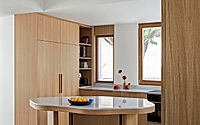
The kitchen unfolds as a warm timber enclave, with cabinetry and window frames in the same tone wrapping around a sculpted central island. That island, with its rounded top and sturdy legs, reads as a domestic table just as much as a work surface, encouraging conversation while someone cooks. Nearby, a more playful room sits slightly apart, its green tiled benches and bright textiles ready to absorb children’s games or a quiet afternoon with a book.
Corners For Rest And Outlook
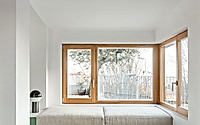
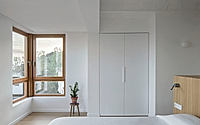
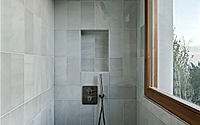
Upstairs, bedrooms and small sitting areas take advantage of the house’s position on the hillside, framing oblique views to trees and skyline through wood-framed windows. Built-in window seats rest on green tiles, turning leftover corners into generous perches where light, view, and storage coincide. Bathrooms use consistent pale tiling and a simple shower recess so circulation stays clear and the focus remains on light, water, and outward views.
Between House And Garden
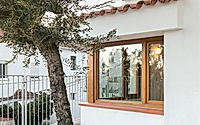
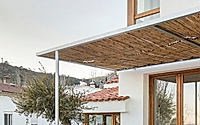
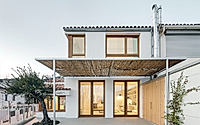
Outside, the reworked elevation gathers previous additions behind a calm white façade, punctuated by aligned openings and a deep porch shaded by a slender pergola. Gravel underfoot, a mature tree, and a timber gate define a forecourt that acts as another room, sliding between street and interior with little ceremony. From here, the unified volumes, clearer plan, and generous glazing read as one continuous journey from garden to stair, from stair to sky.
In daily use, the house now relies on its clarified structure and open circulation rather than excess partitions to organize family life. Light, air, and modest built-in elements support multiple ways of living, leaving room for the occupants to redraw their own routes over time.
Photography by Del Rio Bani
Visit Atzur