Casa SC: Adaptive Barn Home in Menfi with Soulful Rural Character
Casa SC stands in Menfi, Italy, where Vid’A reworks a late 19th-century barn into a contemporary house without erasing its agricultural past. Thick walls, low arches, and a perforated brick screen now frame domestic life while holding onto the traces of work and storage that once filled the volume. The project reads as a careful recovery of character rather than a cosmetic update.


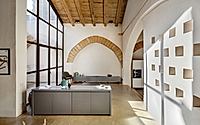
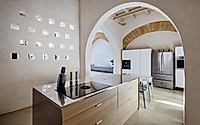
Beams of light enter through small square holes and cast moving patterns on the light-colored walls. Air still flows through the old barn, but today it encounters furnishings, inhabited surfaces, and a different kind of domestic tranquility. The agricultural structure has not been erased; it lives on in every facade and every shadow.
This former agricultural warehouse in Menfi, converted into a home by Vid’A, remains anchored to its rural origins. The project works by subtraction and continuity, choosing to maintain the large single space, the lowered arches, and the imperfect walls as the backbone of the living space. The conversion from barn to residence does not seek a new, autonomous image, but works on the relationship between constructional memory and contemporary use, giving weight to limitations as a resource.
Preserving the Original Volume
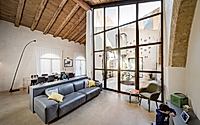
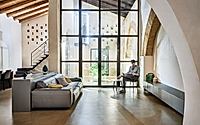
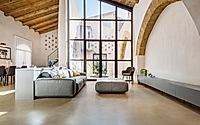
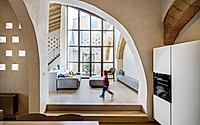
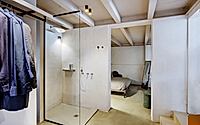
The large barn space remains the heart of the house, a unique environment where the main functions of daily life are condensed. The generous heights are not reduced by mezzanines or false ceilings, but enhanced by the recovered wooden roof, left exposed, which guides the eye upwards with a regular rhythm. The existing arches continue to mark the longitudinal depth, becoming thresholds rather than walls, allowing a continuous sequence between living areas, passageways, and internal views.
The thick, weathered load-bearing walls have not been smoothed to neutrality. They remain textured, slightly irregular, capable of absorbing light and reflecting it with a subtle grain. This choice rejects the idea of a perfect box, maintaining the perception of a rural envelope that now houses a different way of living but does not deny its origins.
Making Light Structure
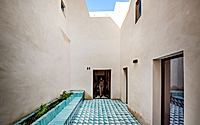
The perforated wall of the old barn, created to ventilate the storage area, becomes a central feature in the interpretation of the house. The small square holes filter the light into precise beams that shatter on the light surfaces, tracing changing patterns throughout the day. This is not a decorative gesture; it is an agricultural function that becomes a perceptual quality, almost an immaterial structure made of shadows and diaphragms.
This grid of solids and voids works with the other light sources to create a subtle hierarchy between inside and outside. The house does not open completely onto the landscape, preferring to modulate relationships, alternating between protected areas and filtered views. Light enters but does not invade, following ancient rules reinterpreted for a different everyday life.
Introducing the Internal Courtyard
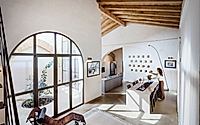
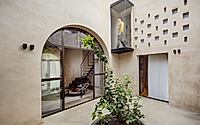
In the deep body of the building, the project carves out an internal courtyard as a measured void. It is not a spectacular gesture, but a calibrated absence that brings air, zenithal light, and a new relationship with the sky. At the center, the tree becomes a visual and sensory focal point, a living root that connects the floor with the height of the walls and the wooden roof.
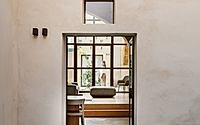
The large glass surfaces overlooking this courtyard connect the different rooms without dissolving the sense of protection provided by the historic walls. The small suspended glass volume, resting like an autonomous object in the cavity of the courtyard, introduces a different scale of perception and shows how contemporary intervention can be legibly inserted into an ancient structure.
Declaring Contemporary Grafts
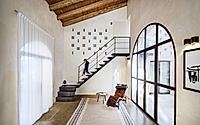
The new elements do not seek to mimic the old. The large floor-to-ceiling window, with its dark, rigorous frame, is grafted onto the existing walls, making the entire original volume perceptible. The light, linear iron staircase is configured as an autonomous structure, detached just enough to declare its own time. Each contemporary insertion dialogues with the rural construction but does not disguise itself, accepting to show itself as a subsequent layer.
The choice of materials follows the same logic of measured continuity. Lime plaster, continuous flooring in neutral tones, natural wood, and burnished iron create a homogeneous but not smooth background, in which small imperfections and traces of time remain visible. There is no nostalgia, only recognition of a constructive history that becomes part of contemporary life.
In the end, the restored house could not be transported elsewhere. The simple monumentality of the barn, made of arches, filtered light, and wood, remains faithful to its identity even in its new use. The project demonstrates how, today, the truly innovative act can consist in respecting what already exists and in the ability to transform it into a living structure for contemporary living.
Photography by Lamberto Rubino
Visit Vid’A