Red Rock — Shaping Harsh Desert Climate into a Courtyard Home Retreat
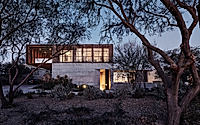
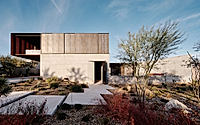
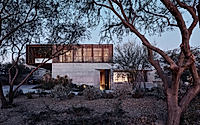
Red Rock sits on a Las Vegas, NV, United States parcel that looks east to the Strip and west to Red Rock Canyon. Faulkner Architects shapes this 2024 house as a low, earthbound composition that leans into the harsh desert climate rather than resisting it. Concrete, water, and shaded courts work together so daily life tracks the shifting light, wind, and temperature through the day and across the seasons.


Wind scours the parcel while the Strip flickers in the distance. Harsh light slants across concrete walls and a still basin of water holds the city’s reflection.
This is a house built for climate before anything else. Red Rock, a single-family house in Las Vegas by Faulkner Architects, orients every move around sun, wind, heat, and dryness. The project answers the exposed desert setting with mass, shade, and a below-grade world that pulls daily life into calmer air.
Set on three-quarters of an acre between Red Rock Canyon and the Las Vegas Strip, the house works as a protective instrument rather than a backdrop. Over half of the built area sits below grade, cooled and lit by precisely cut openings that let daylight and air slip into the concrete structure. Heavy walls, a reflective roof, and a 45 KW photovoltaic array respond to climate head-on, so comfort grows from orientation and mass instead of mechanical excess.
Carving Courtyards From Mass
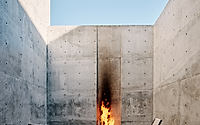
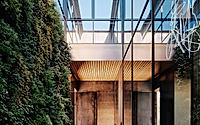
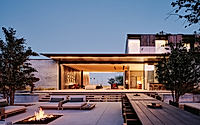
The composition starts as a solid and then subtracts. A narrow opening slices into the concrete to form the entry, tightening the approach before it expands again. Just inside, a shaded passage ramps gently upward and releases into an open-to-sky court planted with vertical clusters of native species, a pocket of landscape held within the mass.
To the east, a wind-protected court answers the Strip beyond. The house wraps this outdoor room so residents can step outside even in strong desert gusts, using the building itself as windbreak and screen.
Water As Counterpoint
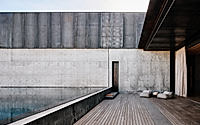
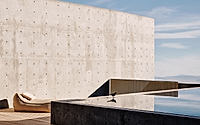
An elevated basin of water mirrors the dimensions of the main living volume. Its surface doubles the distant city profile, turning Las Vegas into a flickering line on a horizontal plane of water. Several openings sit below the basin’s water level, letting filtered light reach interior rooms while the mass of water tempers heat above.
The water’s presence is deliberately fragile in this dry climate. It underscores how dependent the city is on imported resources, even as it cools the immediate microclimate around the house and frames the view.
Living Below The Desert Line
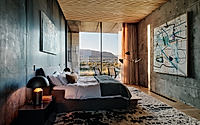
Concrete walls and floors mix locally sourced sand, gravel, and fly ash, giving the interior a buff hue that ties back to surrounding mountains. These elements rise from below grade, so the house reads as landscape lifted into habitable form. Openings cut into the mass admit shafts of sunlight that track across floors and walls through the day.
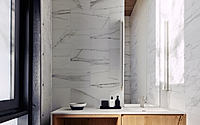
Ventilated below-grade rooms gain steady temperatures without deep conditioning. Life drops slightly beneath the desert surface, where glare softens and views are carefully edited to sky, court, and canyon edge.
Screens, Shade, And Orientation
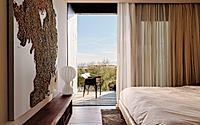
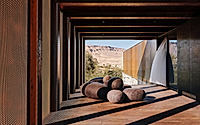
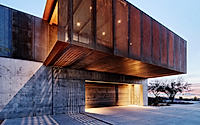
Upper-level sleeping rooms sit within a screened frame sheathed in perforated weathering steel. This elongated bar runs along the east–west axis, shielding the pool from low sun and from wind. Perforated mesh wraps a south-side deck that stretches over the main form, shading both the structure and the cars below.
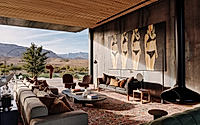
From the deck, the panorama runs from the rust-toned Red Rock Canyon to the neon line of the Strip. The cantilevered volume counterbalances the basin, turning the whole composition into a measured dialogue between earth-like ground form and weathered steel shell, tuned to the desert’s harsh cycles.
In the end, Red Rock reads as part building, part ground, and part environmental device. Concrete, water, and perforated metal settle into the Las Vegas Valley’s geology and climate rather than resisting them. As day turns to night, the house pivots gently between canyon shadow and city glow, always keyed to the desert air that shapes it.
Photography by Joe Fletcher
Visit Faulkner Architects