House 720 Degrees by Fernanda Canales Arquitectura
House 720 Degrees stands in Valle de Bravo, Mexico, as an off-grid house by Fernanda Canales Arquitectura shaped around climate, light, and terrain. The project draws two families and their guests into a circular sequence that tracks sun, rain, and daily temperature swings with the precision of a solar clock. Its courtyard core, detached volumes, and earthen walls keep the remote valley both sheltered and wide open.


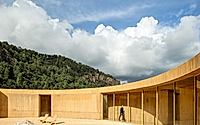
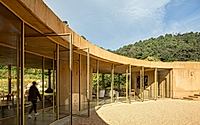
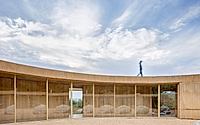
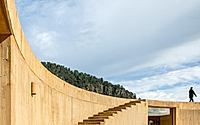
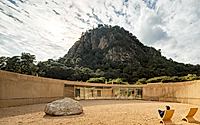
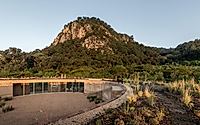
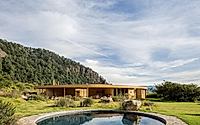
Low earth-toned walls rise from the valley floor, cutting a precise circle against the forest and prairie. Morning light brushes the inner courtyard while distant mountain and volcano views unfurl along the outer ring.
This is a house that reads the weather. Conceived as a geometric instrument in Valle de Bravo, Mexico, the off-grid residence by Fernanda Canales Arquitectura doubles the usual 360-degree field of view. It pivots on context: seclusion and aperture, forest and grassland, sun and hard rain all register in its plan, materials, and daily routines.
Living With Extremes
The valley swings through intense shifts, with temperatures that can vary by 30°C in a day and rainfall dominating half the year. Against that backdrop, the house becomes a mediator between shelter and exposure, tightening around its central patio at night yet opening wide along the circular perimeter during the day. Walls work as membranes between forest and prairie, between dry and wet seasons, so interiors stay tempered without giving up contact with the surrounding land.
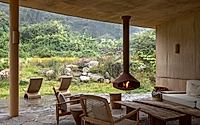
During bright hours, rooms frame a mountain and a volcano while long apertures track the sun’s path around the circle. At night, life contracts toward the courtyard, where protected terraces catch cooler air and reflected light. Each orientation feels deliberate, turning a remote site into a daily reading of climate rather than a retreat from it.
Circular House, Layered Worlds
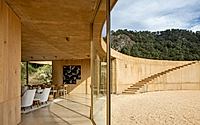
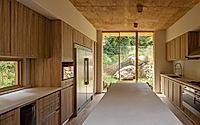
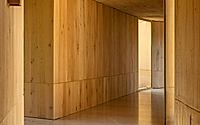
The main circular volume holds the core routines of two families, set around that central courtyard like rooms around a dial. Rectangular bedrooms, bathrooms, closets, and a kitchen slot into the round plan, leaving the curved walls free for circulation that runs as a continuous loop. Those arcs extend beyond the built envelope as terraces toward the courtyard and as gardens toward the outer landscape, so the ring never fully closes down.
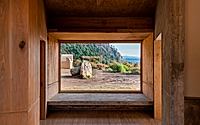
Flexible openings keep the rooms responsive. Privacy screens temper exposure when needed, while large fold-away windows and framed views let each interior connect to two or three orientations. As weather changes across the day, occupants slide, fold, and pivot those elements, turning the circle into a lived instrument rather than a static outline.
Volumes On The Slope
Beyond the circular core, two additional volumes step with the accentuated topography and preserve existing vegetation. A detached studio and guest room sit apart, giving visitors a degree of autonomy while staying within the same climatic field. A rectangular bar with its own patio houses extra bedrooms, storage, and services, spreading the program to match the land’s contours instead of imposing a single footprint.
This distribution matters for daily life. Two families share the property, and the separate pieces create subtle thresholds between shared routines, extended relatives, and guests. Moving between them, people cross patches of forest and open ground, feeling shifts in sun, wind, and shade as part of each passage.
Earth, Water, And Energy
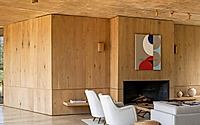
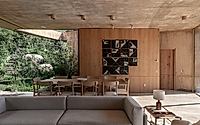
Construction leans on the ground itself, using local soil mixed with concrete to achieve low, durable walls that echo the surrounding terrain. The single-level silhouette keeps the large house visually quiet against untouched scenery, while the material’s color and texture fold slowly into seasonal changes. Lamps and furniture produced on site with local materials extend that approach, giving interiors a continuity with the valley floor underfoot.
Off-grid systems align with the local climate rather than fight it. The house harvests rainwater, generates electricity through solar panels, and uses hydronic radiant floors in bedrooms, with the same solar system heating water throughout. Natural cross-ventilation runs through every room, supported by openings to multiple orientations, so even on heavy days the air moves without mechanical drama.
Durability guides each choice. Weather-resistant materials reduce maintenance and avoid painting or added cladding, allowing the built form to age in parallel with the land. As seasons turn, the house shifts in tone and light, not as an object set apart but as a grounded structure keyed to its valley and sky.
Photography by Camila Cossio
Visit Fernanda Canales Arquitectura