Horno de Pan Opens Toward the City Across the River
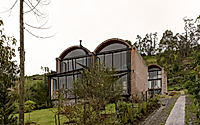
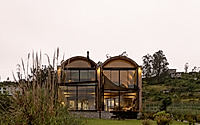
Horno de Pan sits on the hillside of Cerro Auqui in Quito, Ecuador, where Taller General shapes a small house around topography, views, and phased growth. Designed in 2026, the project begins as a compact dwelling and expands through a repeatable brick envelope, using load-bearing walls and a lowered vault to handle structure, roof, and enclosure in one construction system.


About Horno de Pan
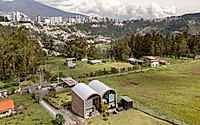
Horno de Pan stands on the hillside of Cerro Auqui, at the edge of Quito, where a river separates the site from the city. The distance is physical but not absolute: downtown remains a short drive away, while the land keeps a rural character and a direct visual relationship with Quito.
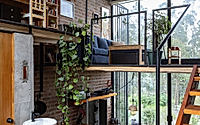
Taller General treats that condition as the project’s starting point. The house faces the views and steps with the moderately sloping terrain, using a series of levels to adapt to the mountain topography rather than flatten it.
Hillside Position
The site is surrounded by eucalyptus trees, pines, orchards, and animals, and the project places this landscape alongside its orientation toward the city. That double relationship gives the house its direction. Interior spaces maintain a direct connection to both city and countryside views, so the building does not turn inward despite its small size.
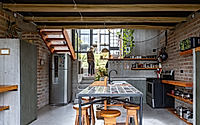
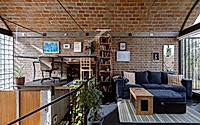
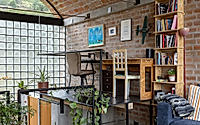
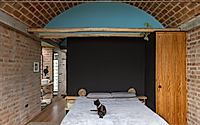
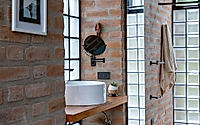
This response to the slope also shapes the domestic sequence. Three interior levels distribute the entrance and bathroom, the living, dining, and kitchen area, and the bedroom and study. The arrangement is compact, but it does not read as compressed. Instead, the shifts in level allow the house to divide its functions while staying within a minimal footprint.
Brick and Vault
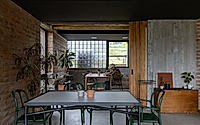
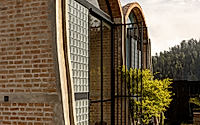
Brick is the project’s central material and structural system. It is chosen for its thermal inertia, which helps maintain interior comfort despite outdoor temperature changes, and it is used to resolve walls, structure, and roof together.
Wide load-bearing brick walls provide mass and enclosure. Above them, a lowered vault allows the roof to be built in brick as a largely horizontal element. Because the house stands in a seismic zone, the vault is reinforced with a 3-cm-thick reinforced concrete layer. The result is a roof that reduces reliance on concrete and steel while keeping the construction system legible throughout the house.
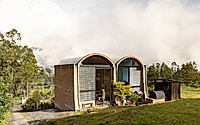
The architects describe the dwelling as a large bread oven on the mountain, and the comparison is useful because it points to the project’s compact volume and continuous envelope rather than to any decorative effect. Brick gives the house a homogeneous outer shell that also supports changes over time.
Growth in Phases
The first phase occupies 40 percent of the final area, providing the main living spaces within 48 m² (517 sq ft). From the outset, the house is planned as a progressive dwelling, with future connections and spatial reorganization already accounted for. That approach allows the initial house to be inhabited while later needs are clarified through use.
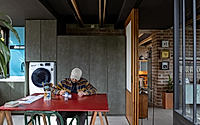
In the next phase, the same brick envelope is repeated. On the ground floor, the dining room sits next to a workshop and laundry room that becomes an interior space. A sliding wooden and fabric screen separates the two while allowing them to connect when needed.
A new platform extends from the living room on a slight slope toward the front garden. This addition is distinct within the brick envelope, projecting outward like an attached box and keeping a spatial relationship with the dining room. The new living room also releases the earlier living area, allowing the kitchen to expand.
Making the Connection
The link between phases is not improvised after the fact. From the beginning, the separating load-bearing wall is planned with cuts on both floors so the two stages can connect later. Those cuts are made as wide as possible without compromising the wall’s structural role.
During the first phase, the openings are covered with fiber cement sheets that can be removed easily and used for storage. In the new phase, those sheets are taken out to free movement on the ground floor. Upstairs, the same material is reused to create double access set perpendicular to the wall for the two bedrooms. The original bedroom becomes a study, library, and television room, while the new upper floor adds two bedrooms and a full bathroom.
What remains most consistent through these changes is the project’s discipline. Horno de Pan grows without abandoning its first construction logic, keeping brick, level changes, and planned openings at the center of how the house meets the hillside and continues over time.
Photography by Jag Studio
Visit Taller General